Portada_AJ_DSC7332watermark

Our work starts to show results

Today was an exhausting day because of the large number of open fronts at the same time as well as the continuous surprises coming up in the last days. Archaeology implies some mystery, improvisation, and investigation… and the uncovering of unsuspected structures require new responses and duties. At the end of the season, the way in which one has adapted to the novelties, surprises, and changes ensures the resolution of the problems and the completion of the tasks proposed at the beginning. 

In the tomb of Djari we have continued –already with the permissions to open the blocked entrance of the subsidiary structure– with the search of the gebel and the lowest level of the entrance. We will still need a couple of days to break the sealed surface prepared here by the authorities in 1995 (according to the inscription therein). On the other hand, the cleaning work in the transversal hall continues with a good pace, what has allowed us to document the gebel and ponder about the concentration of mudbricks –in an unexpected area– under one of the stelae niches of Djari.

In regard to Dagi, our work has concentrated on the cleaning of the inner section of the eastern sector to document by means of photogrammetry. Here we have located a shaft that was not mentioned by Davies in his excavations and study of the “vizier Daga”, which requires previous consolidation of the surrounding paintings before even starting to remove any material from the area of the possible shaft. We will probably continue cleaning this shaft by next season.

As concerns the tomb of Ipi, Miguel Ángel has continued with the study of the design of the chamber and the installation of the sarcophagus and the (stone) canopic box, providing interesting interpretations about the disposition of these items in the chamber.

On the other hand, in relation to the work of our restorers and photographers, we have received some good news: we will be able to use a nearby storage where we will be able to leave some of our collection of materials and they will be able to work there with the findings.

The restoration team has continued with the preparation and testing of the plasters and morters, which they seem to be working very well in the case of Djari and likewise in the tomb of Dagi. Besides, in a couple of days we will proceed to remove the wooden panel covering the painting in one of the sides of the tomb pillars. This is a very special moment for us since the protected paintings have not been seen since almost a century ago.

Portada_DSC5826

The first half of the season is gone! Progress, changes, and strategies

Since very early in the morning, our two photographers Ana and Patri wander around to capture (digitally) each of the most picturesque or scientific episodes that the project might offer at that point. From the balloons packed with tourists that float around with the first morning rays to the initial shovelful of the moostareen (“he of the trowel”), each of the gestures observed in the site helps to portray the progress, efforts, and dynamics of the team members. Our Digging Diary is a clear proof of the superlative work they perform and their continuous (and funny, in occassions!) struggle to catch the best moments, scenes, and happenings.

As temperatures have started to rise, the morning has been very hot. In the complex of Djari, José Alba and Laura have continued with the cleaning of the southern sector in the N passage of the transversal hall. In front of one of the two niches that once decorated the two sides of the tomb façade –and housed two stelae of Djari–, we have found a concentration of mudbricks and a medium-size block of sandstone; we believe that this block was used to seal a burial cut in the rock where one of the two niches were, probably in the New Kingdom. After fatur (i.e., breakfast), the visit of the General Manager of the Central Sector, Mr. Ezz Er-Nooby, allowed us to request permission to continue with the opening of the sealed subsidiary structure in the courtyard of Djari.

In the tomb of Dagi, we continued cleaning the transversal hall where a shaft has been identified, and collecting painted wall fragments and Coptic remains from the later monastery. Any work in the located shaft requires to consolidate and protect the paintings around the structure before taking any step forward.

As for the conservation team, today they finalized a recipe for the repair mortar they plan to use for emergency stabilization on the wall paintings in both Djari and Dagi. They have also established recipes for two other mortars with different properties which they will be able to use in other areas of the wall paintings – one to strengthen the stone substrate, and the other for aesthetic fills. During their testing they have learned the best way to source and process the local materials they are using with the help of the inspectors, which means they can now prepare larger quantities of these materials in preparation for future treatments.

Regarding the conservation work at Dagi’s tomb, as cleaning progresses in Dagi and more wall painting fragments are uncovered, the conservation team has been on hand to perform emergency stabilization and block lifting of these fragile objects. They are working with the archaeological and photography teams to make sure that every fragment is recorded, cleaned, and photographed before further treatment will take place.

In the afternoon, we have organized a mid-season meeting to clarify objectives, reconsider strategies, and modify some plans to reach the original (and new) goals. In this meeting the members of the project have discussed the various difficulties and confident steps they have found in these two weeks and have presented some adjustments to the previous plans to secure the achievement of the goals.

_DSC5039

Architects, artists, and stonemasons everywhere

The inquiry What do you feel when you discover an object that has not been seen by anyone in thousands of year? allows for many kinds of responses, from the often flamboyant and pompous answers to the much more serious and informed replies. Beyond the good vibes and splendour of a significant discovery, the perform of a researcher in a project such as ours requires documenting, analyzing, and assessing the context, nature, and characteristics of the finding. This makes very complicated –even if it seems humanly impossible– to get captivated or let emotions appear. However, any researcher understands and celebrates a good discovery, which in most cases is the result of an investment of time and research, on the one hand, and the collaboration of other people before and during the fieldwork.

Today we have continued with our investigations in the funerary complex of Djari. We are interested on getting access into the subsidiary chamber, though we do need permission from the Ministry of Antiquities and its local authorities in the taftish. It is very clear to us that we must improve the documentation kept for this tomb, its façade and courtyard. No doubt, this structure –which has gone unnoticed by most of scholars publishing plans of the monument TT 366– will provide new information about the architectural typology of this kind of complexes and the ritual activities performed in them. In addition, in the complex of Djari, over the hill where the tomb is located, we have stationed one of the most skillful workers, Antar, who is preparing an enclosure wall for access and protection of the monument that might have been the delight of the ancient Egyptian architects.

Regarding the tomb of Dagi, today we decided to expand the investigation of some stratigraphic units from inside the transversal hall into the outer section; one must consider that in antiquity there was no mid-wall dividing up these two sections, but when the Ministry of Antiquities rebuilt the monument, they decided to build a mid-wall to impede access through them. The cleaning of the outer section of the area in-between pillars has confirmed that the architects designing the monument use mudbricks as part of the eastern section to level the irregular floor of the gebel therein.

Besides this, our expert on stone restoration Miguel Ángel has continued with his work in the funerary chamber of Ipi, where he has identified marks of stonemasons, which could be very useful to understand how the sarcophagus was cut and prepared for this chamber. The weight of this sarcophagus is, approximately, 12 tons.

Regarding the conservation team, today Jaume and Ella worked in Dagi to clean the wall painting fragments prior to their photography. Some of the painted fragments need cleaning to better see the beautiful iconography and texts underneath the thousands of years of dirt. This enables the photography team to capture all their features for future study and publications. Other fragments needed consolidation, which is the application of dilute adhesives in order to stabilize the fragile edges of the mud and plaster.

At the complex of Djari, on the other hand, Reed and Olivia continued testing mortar recipes based on hib, a local clay. They have now tested three different kinds of hib from different sources within the necropolis. Since each type of hib has it’s own unique properties, they are considering the different kinds of mortars they can make. For now they are focusing on one kind of hib in particular for use in Djari, and they have collected a large amount from the source near the tomb, which they are now preparing by hand. This process mirrors what ancient craftspeople probably would have done to source and prepare the material we see preserved on the walls today.

Portada_DSC5508

History as a vanilla slice cake

One of the most common features of the ancient Egyptian monuments is their capacity to face the passing of time through the overlap of multiple layers of use. A well-known example is the case of the famous temple of Luxor, whose function as a cultic place for Amun-of-Ipet came to vanish and then became a fortress for Roman legionaries in the 2nd century BCE and later –during the Fatimid Caliphate period (909-1171 d.n.e.)– it gave place to a mosque dedicated to the sheikh (i.e., saint) Yussuf Al-Haggag, a local figure of whom it is said that he was the introducer of Islam into Luxor. The complex overlapping of societies, cultures, and materials poses a convoluted enigma for historians, philologists, and archaeologists, although the search for “the historical” through the material strata and social episodes is one of the incentives for research. Surely, this feeling is what has taken us here…

Today we got a very productive morning. The southern corner of Djari’s courtyard has revealed the lower part of the sealed entrance (closed in modern times: 23/12/1995), which we found last week and hope to open and examine soon. According to the extant plans, this sector of the complex included a subsidiary structure (maybe a tomb for a dependant of Djari?) with a short corridor and a small chamber. We will examine and document the structure so that we can include it to the latest plans and reconstructions of the tomb.

José Alba and Laura will supervise the cleaning of this sector and the documentation of this subsidiary structure. They will also continue cleaning the northern side of the transversal hall, in which some mudbricks marking a later burial chapel have been found.

In the tomb of Dagi, Raúl, Carmen and Jaime continued at full speed with the documentation and cleaning of the entrance space between pillars 2 and 3. On Thursday, they almost finished the cleaning of the floor between these two pillars, and today they completed the task, revealing bricks that were once used to level the surface where the gebel descended dramatically, as well as a kind of perforation in the floor, probably produced by Coptic monks from the monastery of St Epiphanius who modified several rooms for their incorporation into the activities of production, exploitation and seclusion that characterize their lives in this place.

This morning the conservation team were joined by our restoration inspectors for the season, Karima and Ahmed. They work in the Manager Restoration Office supervising the inspectors of the area. They both visited the site last week to discuss plans for the treatment of the wall paintings, and today they helped the team to refine their recipe for a repair mortar. Using the mixture they had developed on Thursday, the team began making slight variations to the composition in order to identify the ideal working properties, strength, and color of their plaster.

Ahmed and Karima have a lot of experience working with local materials, and were invaluable to this process. They proposed a new way of incorporating straw into the plaster, and when the team was considering how to achieve the desired color, Ahmed went to another area of the mountain and collected hib from a different source. This hib has a warmer color and finer texture which will help the plaster blend into the walls. The goal tomorrow will be to incorporate this new hib into the mixture they have developed. With every test, the team is learning more and more about these important local materials.

_DSC5275

Heru nefer!

Today Friday was a day off for all our team members. Considering the excitement of the first weekend in Luxor and the arrival of the high temperatures, our members planned three possible options to profit from their day off. Some members thought that archaeology, conservation, and epigraphy should be replaced for a few hours with leisure and fun in the swimming pool. Because of this, the group decided to spend its day off in a swimming pool spending some hours in the water and the sun loungers of the Hilton Luxor Hotel.

Another group contemplated the idea of paying a visit to the temple of Karnak without sacrificing a good afternoon in the swimming pool with the other colleagues. Thus, they conducted their visit to the complex of Amun in Karnak early in the morning so that they could enjoy the examination of the textual and iconographic programs of a theological movement that would make it at national level.

A third group of team members decided to stay at the Marsam Hotel catching up with delayed tasks or trying to get on with their plans; in the afternoon, some of them spent some time in the temple of Ramses III at Medinet Habu. At the end, they enjoyed a cold lemonade and the amazing company of the owners of Café Maratonga in front of the temple.

In the end, it was a great day for relaxing and preparing the coming work; this week will be full of intensive work and many surprises as one can expect from such an enigmatic place as the Theban necropolis.

Portada_AJ_DSC6555watermark

Mud madness

In Djari’s funeral, his mummified body was left in a ritual hut (wabet?), two assistants protected the corpse and a sem officiant performen the rites for his transformation and journey to the netherworld. His tomb was orientated to the Eastern Bank where the imminent cult of Amun had just emerged with the absolute support of the Theban echelons. Meantime, the builders and artists of his complex considered the most effective compositions to reflect –as a theological and social matter– the splendour of the Egyptian world and the significant impact of the cult to Hathor, patron goddess of the Theban mountain in the West Bank. These are some of the themes that governed the decorative programs that we expect to document and publish in this season and the next ones.

Today we have continued with the excavation of the section between pillars 2 and 3 in the saff façade of Dagi. This has brought about a series of nice surprises, such as the appearance of a Coptic level with a modification of the gebel, which might have been used for some kind of textile installation or the use of mudbricks in the external side of the entrance between pillars 2 and 3 to level the severe drop of the bedrock in the area.

In the case of Djari, the cleaning of the transversal corridor has also provided us with interesting information such as the order of collapse of the ceiling in various sections of the corridor; in addition, the cleaning of the southern corner of the complex has revealed a sealed gate produced by the Supreme Council of Antiquities on 23 December 1995. The GIS team has reached the second phase of the DEM and GCPs collection with the visit to Dra Abu el-Naga. Together with El-Tarif, Deir el-Bahaari and Asasif, this incorpoation allows us to expand our network of points to the north with a series of significant (geolocalized) topographical points that will be very useful not only for the project but also for other missions in the area.

As for our conservation team, this morning in the tomb of Dagi its members finished documentation of the special finds that had been sorted into boxes last season. Of course, now that cleaning has stated there will be much more work for them in the coming days!

In the case of Djari’s complex, in the afternoon the conservation team was able to beging testing different recipes for repair mortars. They have based their recipes on analysis of the original materials used in the wall paintings, which include mud from the Nile and hib, a local clay-containing soil from the Theban mountains. After many tests and conversations with rais Ali and the workmen, who have extensive knowledge of these materials, the team has selected a suitable recipe to continue developing for their treatments. 

Portada_AJ_0014544_watermark

Some structures see the light…

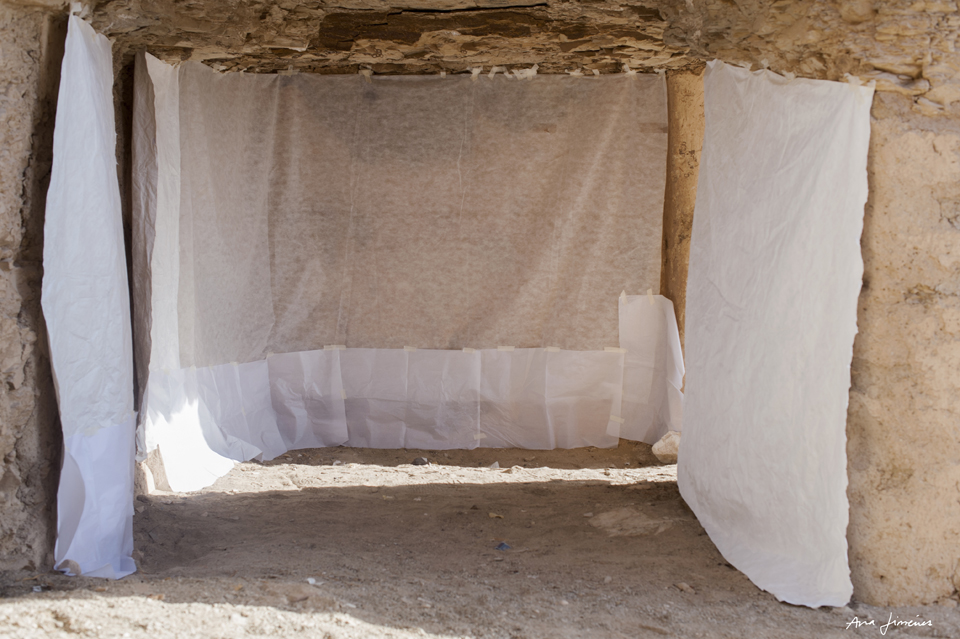
This morning we have enjoyed a very intensive day of much activity with multiple tasks and very good feelings. With the support of one of our inspectors, Mohamed, the GIS team has explored the site of El-Tarif, where they have taken points for the composition of our Digital Elevation Model (or DEM in abbreviated form). This will allow us to understand the Theban landscape in a better way.

Jesús and Kate (to whom José Pérez will join soon!) have developed a complete plan of work including not only El-Tarif but also Dra Abu el-Naga, Sheikh Abd el-Qurna, Asasif South and even some parts of Karnak in the East Bank. They are using a GNSS receiver Trimble R12 that connects with a satellite network of data correction in real time and allows us to take points in a quick fashion.

On the other hand, our archaeologists have faced their initial problems with the cleaning work in the transversal hall. While José Alba and Laura aimed at finding the bedrock (i.e., original floor of the tomb of Djari) surrounded by the especial fabrics installed here to cover the paintings, other workmen led by rais Alí continued cleaning the pile of debris at the southern slope in the complex. The removal of these remains (most of them modern!) will allow us to recover the complete plan of the saff façade and examine the southernmost pillar, which has been covered for many years. In fact, the publication of the tomb by Herbert Winlock and the Porter & Moss topogaphical bibliography do not include that area in their plans. At the end of the day, the cleaning of the transversal corridor has led us to the white limestone bedrock, which shows a fragile aspect and requires more work for its preservation (and to avoid stepping on it).

Regarding the tomb of Dagi, the cleaning of the easternmost section of the transversall hall has been initiated with the removal of the most superficial strata (mainly mud brought by heavy rains and fragments fallen from the tomb ceiling or its walls) and the search of the bedrock, which we hope to find tomorrow Thursday.

This morning members of the conservation team visited Djari to hang the protective coverings that they had tested yesterday in preparation for cleaning and excavating of the ground. Regarding Dagi’s tomb, the conservation team continued documentation of special finds, mainly consisting of decorated wall painting fragments, and have begun discussing the iconographic features they are seeing. So far, they have found multiple pieces that seem to belong to a geometric frieze and a Kheker relief that would have framed some of the scenes. This has allowed them to compare the fragments with the wall paintings that remain in Dagi, and it seems that certain areas were painted by different artists, as there are variations in their stylistics techniques. It is amazing to imagine how many different hands may have contributed to the decoration of this tomb. Some fragments also include hieroglyphs and Jaume has been tutoring the other team members about their meaning.

In discussion with Raúl and Antonio, they have begun recording the different layers of plaster that remain on the wall. Interestingly, in some sections there are up to four layers of preparatory mud plaster. This likely would have been done to smooth and make even the surface of the wall in preparation for painting. As they are now considering how they might reattach fragments to the wall once they have identified their original position, the conservation team will be learning from the craftspeople of the past in order to develop similar methods.

Portada_DSC4763

From Mentuhotep II to St Epiphanius

This year, one of the ramifications of working in the Asasif sector is that the situation allows us to face very different problems from the ones we experienced in the complexes of Henenu (TT 313) and Ipi (TT 315) in the northern hill of Deir el-Bahari.

In opposition to the considerable courtyards and the multiplicity of subsidiary chambers as found in the complexes of Henenu and Ipi, the tombs of Djari and Dagi welcome the visitors with a local architecture based on a very characteristic saff façade, a smaller courtyard, and colorful paintings imbued with significant symbolism. An example of the mythological meaning of these scenes is the presence of a sycomore fig tree loaded with figs that some men tried to collect –scene attested in both tombs–, which tells us about the patron goddess of the necropolis in this area, Hathor.

Another situation posed by the current season work is the presence of archaeological remains that expand from the reign of Mentuhotep II (beginning of the second milennium BCE) to the time of the followers of St Epiphanius of Thebes (s. VI AD). The types of analysis, documentation, and interpretations required by structures of mudbrick and stone bound over the centuries is really demanding. Thus, our team of archaeologists face these convoluted contexts, structures, and findings with good discussions, much observation, and the application of the most suitable methods and techniques. That is the reason why it is normal to see that we move from discussing the finalization of the cleaning in the southern slope to the interpretation of the accummulation of various levels and strata from Coptic times over the Middle Kingdom remains of Dagi.

Regarding the conservation team, now that we have initiated the cleaning of the transversal corridors it is critical that the conservators work hand in hand with our archaeologists. On the one hand, we just got a new member: Jaume Vilaró.

The first task for the conservation team was testing materials to cover the exposed wall paintings prior to the cleaning that will start in the corridor in the next few days. They tried out two different fabrics which will keep dust from settling on the paintings. They also received the first delivery of local materials they will use to begin testing recipes for repair mortars – with the help of Rais Ali and the workmen they began slaking crushed limestone, which they will investigate as a possible binding material.

In the case of Dagi’s monument, the conservation team continued to assist with the documentation of the wall painting fragments at Dagi, which has allowed them to begin prioritizing certain objects for treatment. This can be due to the fragility of the fragment, but also if they display especially important features which may help them reconstruct the decorative scheme in the future. Examining the fragments has also allowed them to understand some of the conservation challenges they will be facing, and they have started preparing several adhesives to test for the consolidation of the friable plaster layers.

Portada_DSC4491

Warming up motors (and moustareens)

The actions of today represent the final point for a week of bureaucracy, study, and documentation of the façades and transversal corridors of both monuments. Even if Dagi and Djari performed different functions and got buried in two very distinctive areas of the necropolis, each enjoyed a similar position of power. Dagi’s list of titles displays one of the most interesting positions and epithets of the late XI Dynasty. Djari, as prison director, probably dealt with the Herakleopolitan adversaries of Mentuhotep II and the Theban faction. Their monuments reflect their functions, prestige, and resources to built two of the most important tombs in the Theban necropolis at the beginning of the Middle Kingdom.

In Djari’s tomb we were able to complete the 3D model, document the actual conditions of the façade and transversal hall, and prepare the area for further work. The major task of our archaeologists outside will be the cleaning of the southern ramp in its western sector so that workers find it easy to take the materials out of the complex. In this way, we will avoid having to cross the courtyard of Dagi or to exit through the northern steep slope, too hard for our workers. Besides, our team has proceeded to clean the very surface of the transversal hall where we have already distinguished our initial stratigraphic unit (our S.U. 1000). In addition, our conservation team (Ella, Olivia and Reed) –to which Jaume Vilaró will join tomorrow– has explored the areas of the tomb with paintings to consider the best way to cover the walls during the cleaning.

The archaeologists in Dagi’s tomb have also started to prepare a 3D model, which they expect to finish between today and tomorrow. The size of Dagi’s complex require to extend the task for the next two days. Such a type of documentation –obtained by means of photogrammetry– allows us to know much better the actual condition of the tomb and prepare more detailed plans of the work areas and the monument. While our archaeologists conducted these tasks, the workers continued reconstructing the later wall of the monastery of Saint Epiphanius, the Coptic complex located in the tomb of Dagi and his neighbouring tomb of Sobeknakht, whose traces have reached us there.

Tomorrow, we will initiate the cleaning of the transversal corridors and will put in motion our archaeological work strategies, which include the help of our workers specialized with the shovel, the “moustareens”. At the same time, our GIS experts Kate and Jesús get ready for a new phase in their work; they will develop an ambitious plan to get GCPs (“ground control points”) for our Digital Elevation Model (DEM), the geolocalization of our monuments and the study of the landscape and territory around in Thebes.

Portada_AJ_0014100_watermark

A multi-spectral camera?

In the initial days of the Seventh Season the project progresses slowly and carefully. The archaeological teams continue with the documentation of the funerary complexes of Djari and Dagi, aiming at understanding their architecture, rooms, and materials.

In the complex of Djari (TT 366), Sergio has prepared two 3D models by means of photogrammetry. These models correspond to two crucial areas of the season, the southern sector and the tomb façade. The cleaning of the transversal corridor of the tomb by Sergio, Jóse and Laura will allow us to recover wall painted fragments that might have collapsed. These fragments constitute a very important part of the history of the monument, its texts and images that aimed at providing the deceased Djari with life.

In terms of conservation, while José and Laura continued their documentation of Djari, conservators Reed and Olivia began making plans for how to carefully remove the wooden boards that are covering many of the wall paintings. Because we do not yet know the condition of the paintings, they will have to remove the boards one at a time, making sure to document the entire process. They will also have to be ready to stabilize the wall paintings if it is needed, and will begin testing materials for this in the coming days.

In the case of Dagi’s tomb (TT 103), the primary task has been the recollection of the information regarding the tomb façade: structure and materials of the pillars, types of wall scenes, Coptic architectural modifications, inscriptions from the IX Dynasty, graffiti from St. Epiphanius’s monastery (i.e., the monastery created in Dagi’s tomb between the sixth and seventh century AD), etc. All this information will be increased with the production of a 3D model tomorrow. In addition, our photographers have just used for the first time the multi-spectral camera. This devise has the capacity to recollect images with a very wide range of metadata, which makes it very efficient for epigraphy and conservation. As its name indicates, a multi-spectral camera can detect various types of light wavelength across the electromagnetic spectrum, visible and invisible. Multi-spectral imaging can be employed for the investigation of painted walls and inscriptions, and contributes to understanding the nature of the pigments, the agglutinating agent of the compositions, the types of morter and gypsum for the wall base, and even details regarding the artistic skilfulness with a precision that the human eye cannot perceive. Our photographers Patricia and Ana, with much patience and a relevant knowledge of the device, have already tested its capacities and collected the first results. From the flowing brushstrokes used by the artist in the tomb of Djari to represent the tails of oxen and donkeys to the compact appearance of the red pigment as employed in the monument of Dagi… there are many details escaping the human eye that we will soon know with the multi-spectral camera. 

As for the conservation work in Dagi’s monument, today our conservators Reed and Olivia started the morning discussing the unique mudbrick features that remain from the Coptic monastery in the tomb of the visier Dagi with Raúl. Preserving these traces of the continued use of the structure will be an important part of their work in the tomb, even if our main focus is on the Middle Kingdom! Afterwards they visited the eastern corridor with Raúl, where they planned how to protect the wall paintings when the workers start the cleaning in the next few days. There was one area of plaster detaching from the wall, which Reed and Olivia secured with a removable tissue support, to allow the workers to move around the area without causing any damage. This has also allowed them to practice documenting their work with the same system used by the archaeologists, to ensure that all of their work can be coordinated with the rest of the team.

MKTP - Middle Kingdom Theban Project - Recuperando el pasado
logoUAH-footer

El proyecto

El Middle Kingdom Theban Project tiene como objetivos la excavación, estudio y publicación de varias tumbas de la necrópolis del Reino Medio en Deir el-Bahari (Henenu, Ipi, Neferhotep, E1) y de las tumbas de Dagi (TT 103) y Djari (TT 366) en la necrópolis de Asasif.

MKTP - Middle Kingdom Theban Project - Ministerio Egipcio de Antigüedades

Con la colaboración del Ministerio Egipcio de Antigüedades y las autoridades del Alto Egipto, Luxor y la Orilla Occidental.

Las tumbas

Las tumbas de Henenu (TT 313) e Ipi (TT 315) se encuentran en la colina norte de la necrópolis de Deir el-Bahari, donde fueron enterrados algunos de los oficiales más importantes de Mentuhotep II y principios del Reino Medio. 

La cámara funeraria de Harhotep (CG 28023) fue localizada en el patio de la tumba TT 314 y constituye uno de los ejemplos más interesantes en arquitectura, iconografía y epigrafía del yacimiento. 

En la planicie de Asasif, las tumbas de Dagi (TT 103) y Djari (TT 366) también representan monumentos a la memoria de altos cargos tebanos del reinado de Mentuhotep II que ayudaron a construir un gran estado.

MKTP - Middle Kingdom Theban Project - Patrocinadores - Ministerio de Ciencia e Innovación
MKTP - Middle Kingdom Theban Project - Patrocinadores - Gobierno de Castilla-La Mancha
MKTP - Middle Kingdom Theban Project - Patrocinadores - Fundación para el Conocimiento madri+d
MKTP - Middle Kingdom Theban Project - Patrocinadores - Ministerio de Cultura y Deporte
MKTP - Middle Kingdom Theban Project - Patrocinadores - Fundación Palarq
MKTP - Middle Kingdom Theban Project - Patrocinadores - Parque Científico y Tecnológico de Castilla-La Mancha
MKTP - Middle Kingdom Theban Project - Patrocinadores - Asociación Española de Egiptología
MKTP - Middle Kingdom Theban Project - Patrocinadores - Asociación de Amigos de la UAH

Copyright 2020 MKTP ©  Todos los derechos reservados. Editor: Antonio J. Morales
(con la colaboración de miembros MKTP)
Cookies | Privacidad

Sitio Web realizado por MindHouse