Image: Patricia Mora Photography
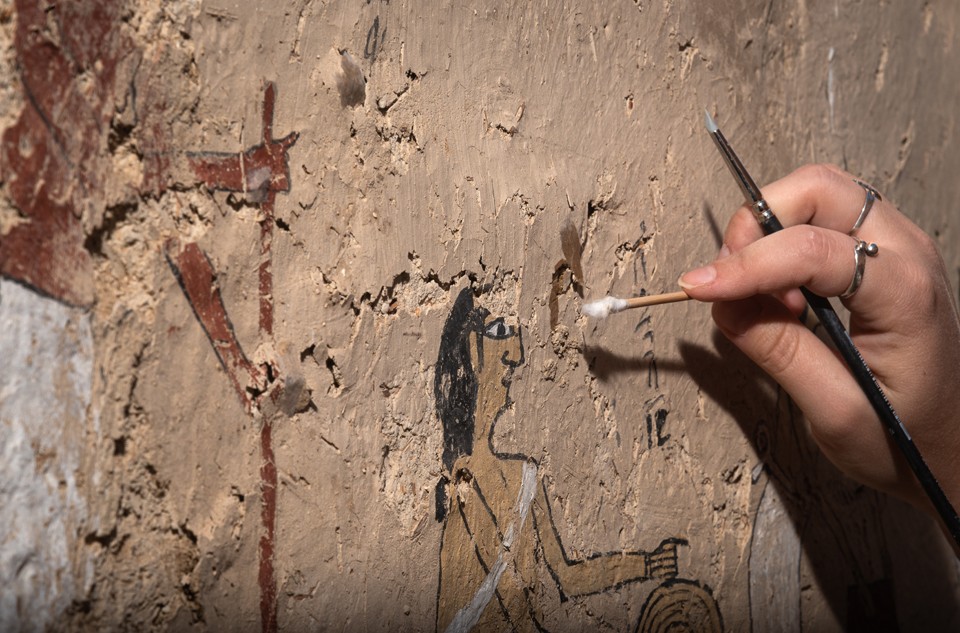
As we have been reporting, the end of the campaign is always marked by stress, intensity, constant rushing, and unfinished plans. In the case of the Ipi complex, the team has succeeded in completing its main objective: dismantling and cataloguing all the loose fragments of the sarcophagus. At the same time, work continues at full speed in the tomb of Djari, director of the kheneret (a term meaning “prison” or “forced labour”), where the sheer number of scenes, spaces, walls, and mortars requires an uneven and necessarily slow pace of work along its surfaces. Even so, progress has been considerable. We now know which types of mortars (with or without lime) are the most suitable, we have identified the behaviour of the pigments, and we are able to apply them appropriately to each wall. Inshaa’llah (“God willing”), in a few campaigns’ time we will be able to say that this work –so difficult to initiate because of its complexity– has been successful and, above all, that the tomb of Djari has been saved and recovered for posterity.
The tomb of Ipi is closing its doors to the MKTP team for this year. The days of a dozen workers under the direction of the unbreakable Miguel (so called for being tough as stone and for pursuing objectives without wavering) have now come to an end. For weeks, Raúl and Rebekah were assigned to the main corridor of the tomb, cataloguing, examining, and documenting each of the large fragments that arrived at their worktable. When it was not a small fragment (weighing only 300 kilos!), it was a limestone block of nearly a tonne that had to be studied in situ. Their work has been exemplary, making the most of every day in order to record everything, miss no detail, document each fragment, and provide a thorough account—through files and notes—of all that was removed from Ipi’s funerary chamber. The three of them, under the nickname “Ipitin” (sic) (= Ipi Team), have greatly enjoyed the experience, forging close ties with the workers and documenting in detail this deconstruction of the sarcophagus, which will one day give way to the reverse process of reconstruction. Further down the same corridor, and this time dealing with much lighter objects, Daniel Sánchez was stationed for a week. With his knowledge and passion, he not only analysed bouquets and garlands but also taught us a great deal about the world of plants, trees, seeds, and fruits.
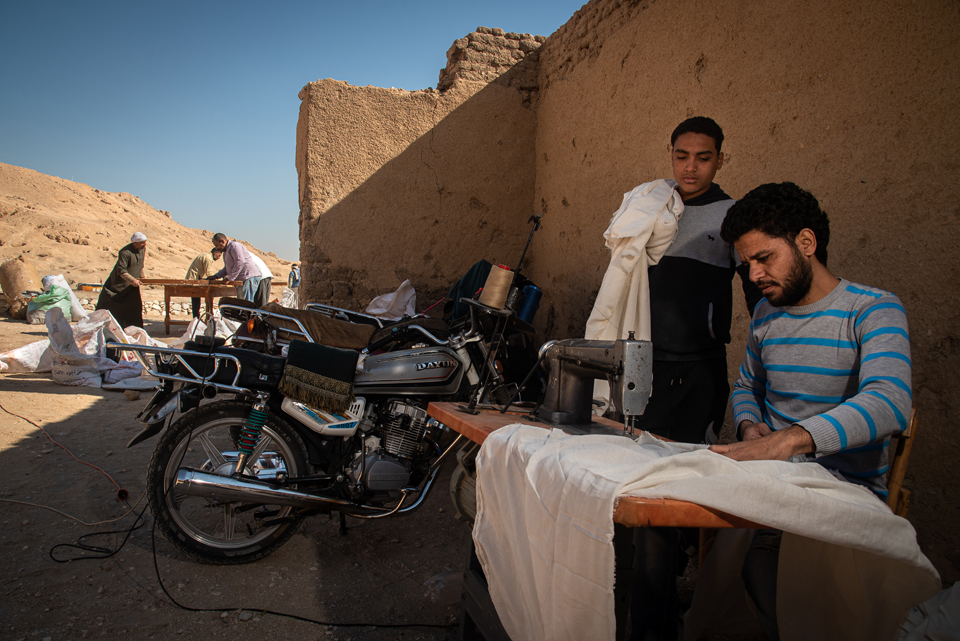
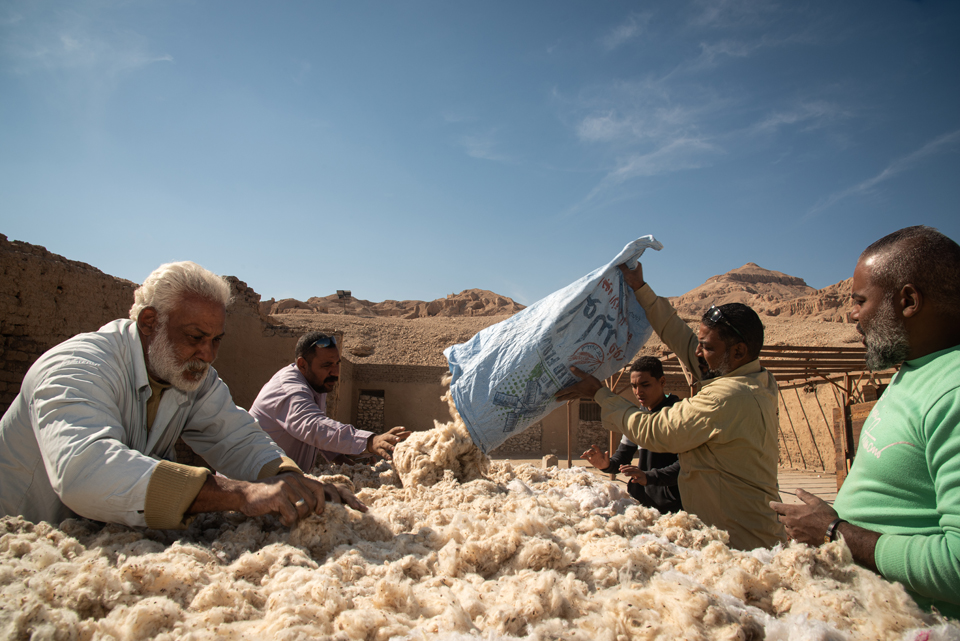
The situation is quite different in the funerary complex of Djari, where restoration and conservation work has occupied the bulk of our efforts, aside from reviewing finds lists from previous campaigns in order to improve the organisation of our inventory. In this case, the patient, slow, yet essential work of our conservators cannot be emphasised enough. Arantxa, Ella, Jaume, and Reed, together with the conservation inspector Sameh, have devoted every day of this month to a process of experimentation, study, observation, application, and finally, confirmation of results. In recent days, the team—especially the moudir—has been pleasantly surprised by the new appearance of the walls which, using mortars very similar to the originals, are beginning to present a more stable architectural aspect. To the constant wit and humour of Ella and Jaume we add the wisdom and patience of Reed and the experienced work of Sameh, resulting in a team that has successfully translated calculations and percentages into a tangible reality on the walls, aspiring to restore this monument. And to all this we add today the interesting work carried out on site by a group of Coptic carpenters, who came to renew the wooden structures, together with their fabrics and materials, which will serve to protect the scenes over the coming months until our return.
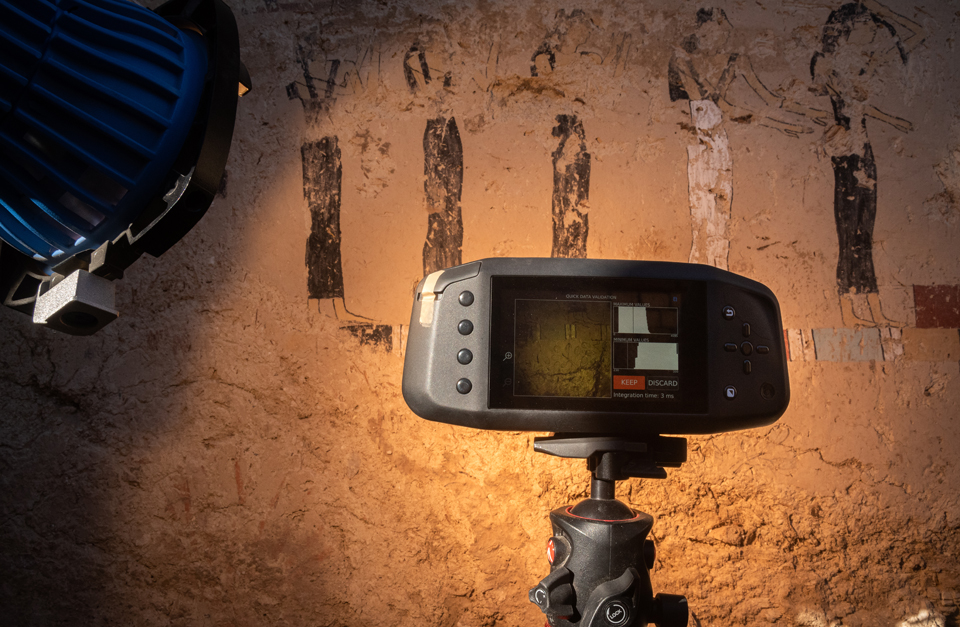
The effort devoted to the blocks of Ipi’s sarcophagus—a “resurrection box” for the mummy of the vizier, which according to our evidence seems to have suffered countless mishaps—and to the paintings of Djari, whose iconographic programme sought to provide the deceased with all manner of privileges, offerings, and foodstuffs, should not cause us to overlook the work of other colleagues who, for weeks, have dedicated their time and energy to specific goals. Some, such as Andrés, focused their stay on the study of scenes like the various fishing activities depicted on one of the walls of the main corridor. Others, such as our photographer Patri Mora, achieved the impossible: being in three places at once—not only wherever she was needed, but also while developing her own programme of documentation of the tomb. Finally, we must not forget Fernando, assigned to work independently on verifying our network of geolocated points in the Theban necropolis, a solitary yet fundamental task for the correct appreciation of space and a better understanding of the surrounding landscape.
To all of them, and as we approach the end of our 2025 adventure, our thanks for their work and for their constant overcoming of problems, questions, and tasks, the result of which will undoubtedly be the production of important studies on these two Theban tombs.


