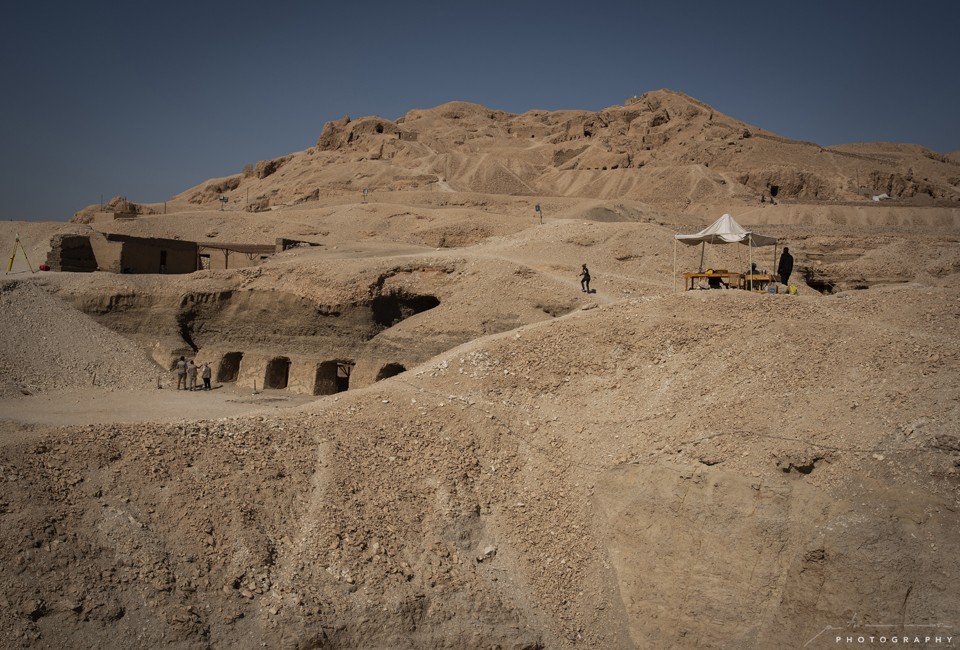
The actions of today represent the final point for a week of bureaucracy, study, and documentation of the façades and transversal corridors of both monuments. Even if Dagi and Djari performed different functions and got buried in two very distinctive areas of the necropolis, each enjoyed a similar position of power. Dagi’s list of titles displays one of the most interesting positions and epithets of the late XI Dynasty. Djari, as prison director, probably dealt with the Herakleopolitan adversaries of Mentuhotep II and the Theban faction. Their monuments reflect their functions, prestige, and resources to built two of the most important tombs in the Theban necropolis at the beginning of the Middle Kingdom.

In Djari’s tomb we were able to complete the 3D model, document the actual conditions of the façade and transversal hall, and prepare the area for further work. The major task of our archaeologists outside will be the cleaning of the southern ramp in its western sector so that workers find it easy to take the materials out of the complex. In this way, we will avoid having to cross the courtyard of Dagi or to exit through the northern steep slope, too hard for our workers. Besides, our team has proceeded to clean the very surface of the transversal hall where we have already distinguished our initial stratigraphic unit (our S.U. 1000). In addition, our conservation team (Ella, Olivia and Reed) –to which Jaume Vilaró will join tomorrow– has explored the areas of the tomb with paintings to consider the best way to cover the walls during the cleaning.

The archaeologists in Dagi’s tomb have also started to prepare a 3D model, which they expect to finish between today and tomorrow. The size of Dagi’s complex require to extend the task for the next two days. Such a type of documentation –obtained by means of photogrammetry– allows us to know much better the actual condition of the tomb and prepare more detailed plans of the work areas and the monument. While our archaeologists conducted these tasks, the workers continued reconstructing the later wall of the monastery of Saint Epiphanius, the Coptic complex located in the tomb of Dagi and his neighbouring tomb of Sobeknakht, whose traces have reached us there.

Tomorrow, we will initiate the cleaning of the transversal corridors and will put in motion our archaeological work strategies, which include the help of our workers specialized with the shovel, the “moustareens”. At the same time, our GIS experts Kate and Jesús get ready for a new phase in their work; they will develop an ambitious plan to get GCPs (“ground control points”) for our Digital Elevation Model (DEM), the geolocalization of our monuments and the study of the landscape and territory around in Thebes.


