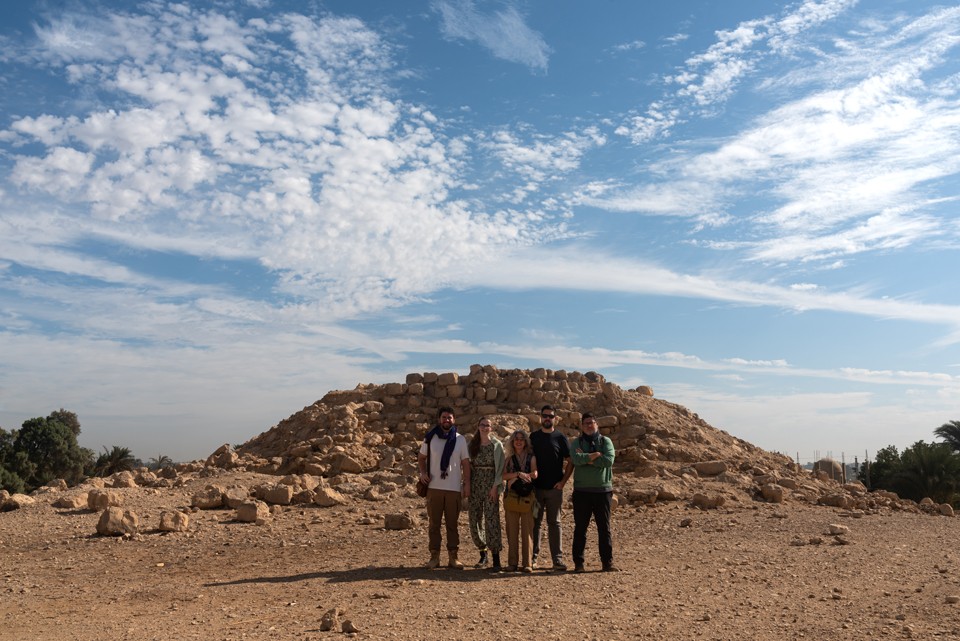
Image: Patricia Mora Photography
On our day off, the team decided to visit the region of Naqada, best known for the archaeological site that gave its name to one of the typological and archaeological sequences used —among others— by Flinders Petrie in his classification of prehistoric cultures. Although we knew that the Predynastic necropolis (with remains from later periods as well) was inaccessible, we took the opportunity to visit the area where the small pyramid of Naqada (or “of Nebut”) stands. This structure belongs to a group of monuments of smaller scale than the funerary pyramids and exemplifies the Old Kingdom’s monumentalization of the landscape—specifically during the reign of Huni—driven by significant ideological and economic motivations. These buildings remain the subject of lively debate, and research teams such as the one led by Richard Bussmann at Zawiyet Sultan continue to gather evidence to better understand the nature and function of these monuments.
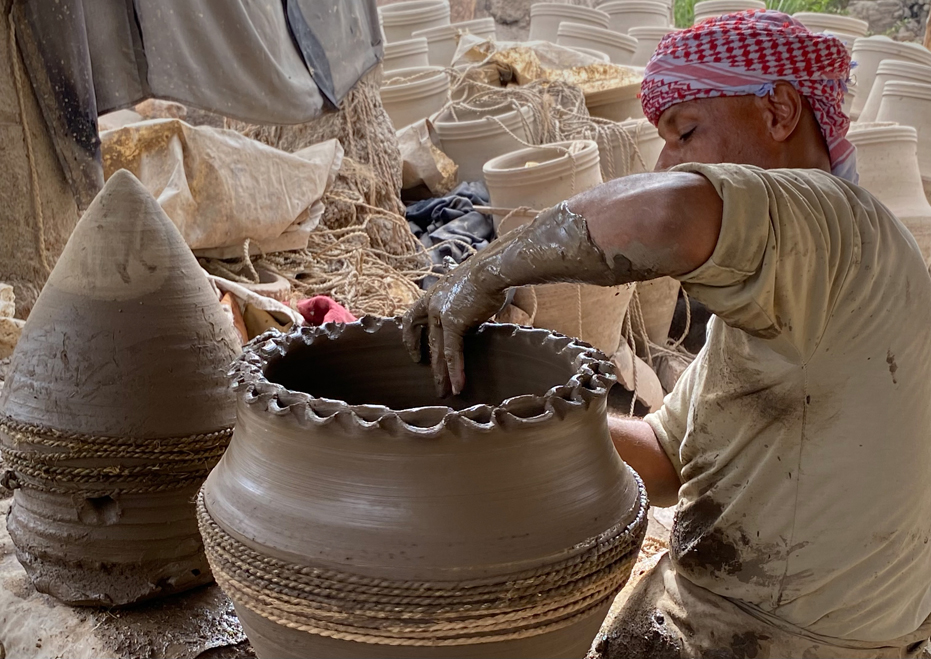
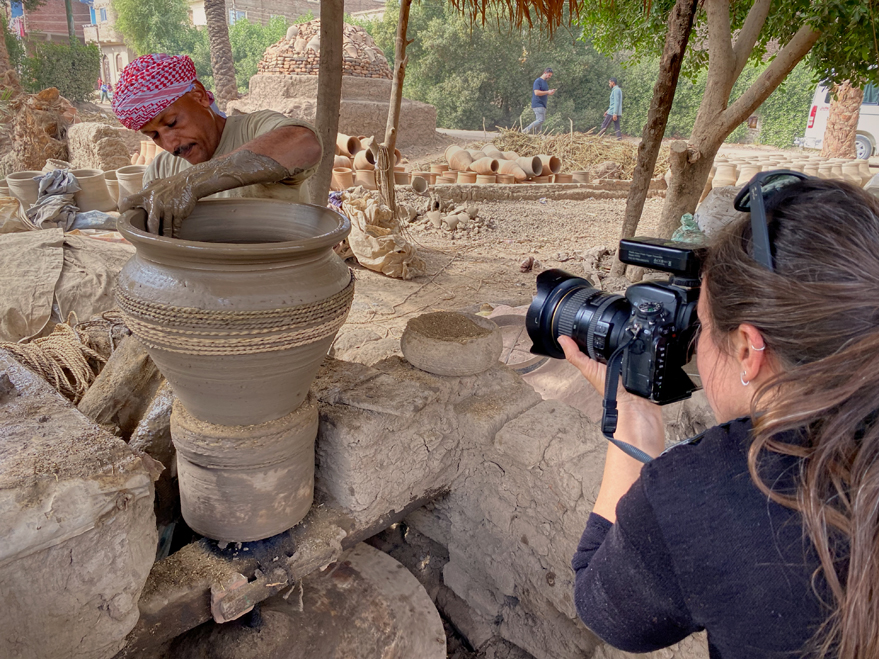
However, Naqada and its surroundings (extending to nearby Deir el-Ballas) are also famous for their ceramic production, their potteries, and the specialists who, over generations, have preserved this craft and source of livelihood within their families and villages. In the village of Toukh, we visited the workshop of the potter Higazi Ali, who welcomed us with the characteristic hospitality of Egypt and spoke about his family’s craft and business while showing us the use of the kick wheel and the types of vessels he can produce. He also showed us the two kilns where they fire their pieces: up to 110 large jars or 200 small ones in a single load. As always, travelling through different corners of Egypt reminds us that, beyond the books, one can still find living evidence of ancient methods, virtually untouched despite the passing centuries. Some examples of these moments suspended in time are donkey transport, the use of the shaduf to lift water into the irrigation channels, or the production of pottery itself. For those who study Egyptian ceramics, understanding the Vienna System is essential, but observing present-day production processes helps illuminate many aspects of ancient techniques.
On the way back from Naqada, some team members took the opportunity to visit the funerary temple of Seti I, located on the boundary between the cemetery of El-Tarif and Dra Abu el-Naga. In this part of the Luxor landscape, diverse experiences converge: the local mosque of the West Bank, the funerary temple of Seti, the modern cemetery of El-Tarif, the ancient necropolis of the Intefs, and the checkpoint—monitored by the police and crossed by thousands of tourists each year—leading to the Valley of the Kings. Those who visited the temple enjoyed its rich inscriptions and iconography and returned to the hotel in the iconic West Bank tuk-tuks.


