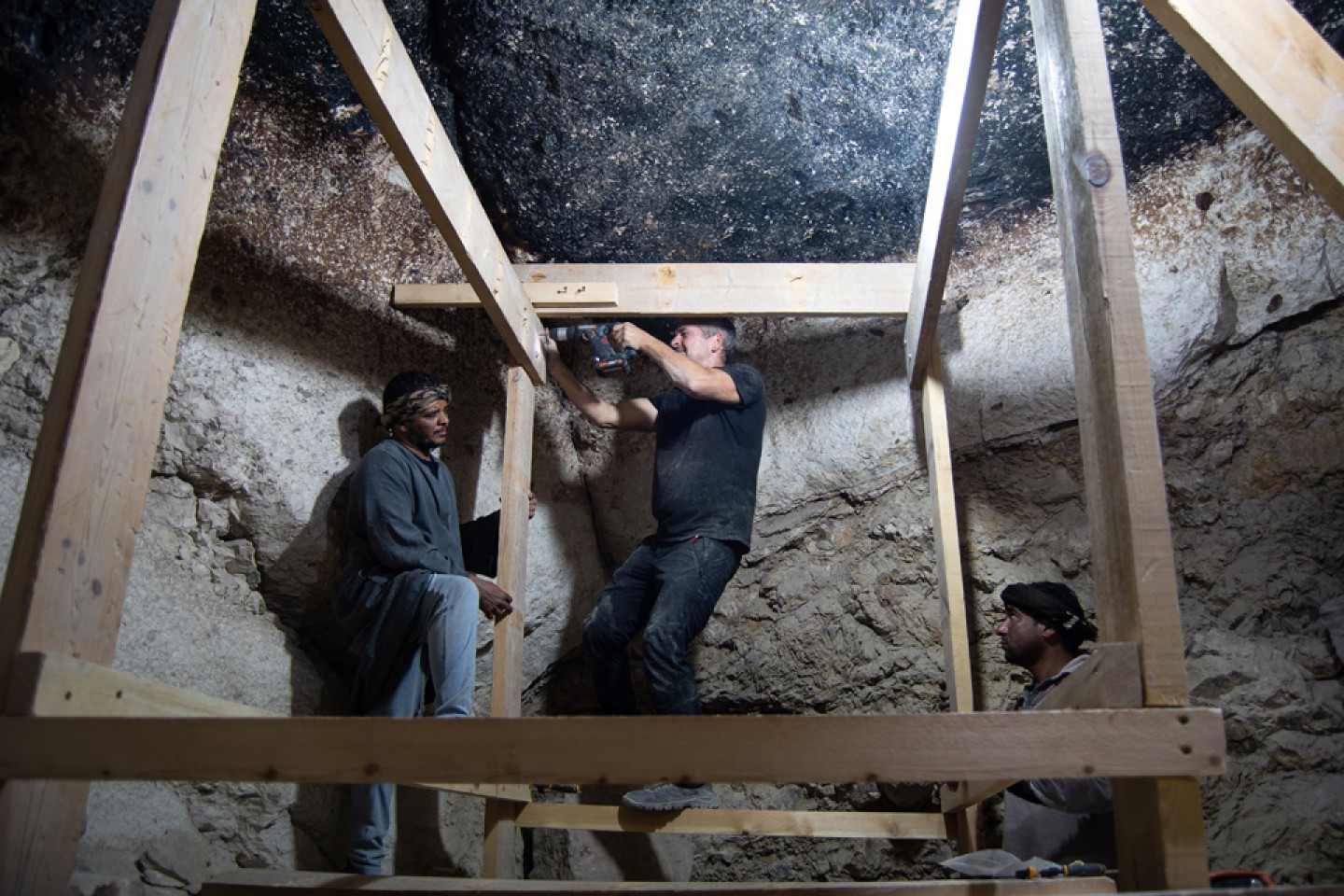
Restoration and conservation work in the tomb of Djari is moving steadily forward. We devoted the first week to preparing materials and studying the current condition of the tomb, including producing alteration maps that will allow us to understand the extent to which each sector of the walls presents issues when we come to intervene. Meanwhile, Miguel continues to make good progress in the burial chamber of the sarcophagus with its dismantling. The small and medium-sized pieces were already removed from the chamber, and we now face a new stage involving blocks that weigh several hundred kilos.
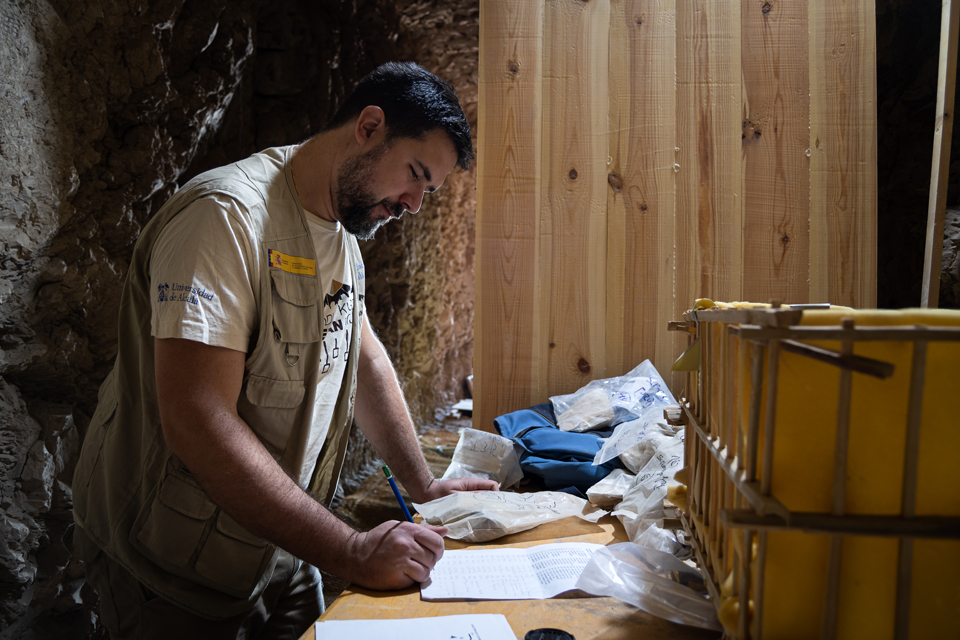
In the tomb of Ipi, we continue to follow the workflow established from the beginning: Miguel works inside the chamber selecting the fragments that will be dismantled and taken out. At first, smaller fragments were chosen—those that could be transported easily without the help of the workmen or the need for a sledge. A little later, the size of some fragments required the use of a sledge built on a wooden platform, which allowed us to move pieces of up to 400 kg. Considering that some blocks of 600–800 kg await us, Miguel has begun to build a structure that will allow the use of a winch (a mechanical device with a rotating drum that winds a cable or rope, enabling heavy objects to be lifted or moved).

Meanwhile, above ground, Rebekah labels each fragment and records its essential information —above all to establish its exact location on the “wall map” we are designing for each side. Although Rebekah handled the inventory and data collection during the first few days, she was joined two days ago by Raúl Sánchez, who will remain with the team for the rest of the season. The final phase of this workflow is carried out by the conservators, who perform an initial, straightforward intervention on each piece—one that will be expanded and refined once the fragments are reunited with the main sarcophagus.
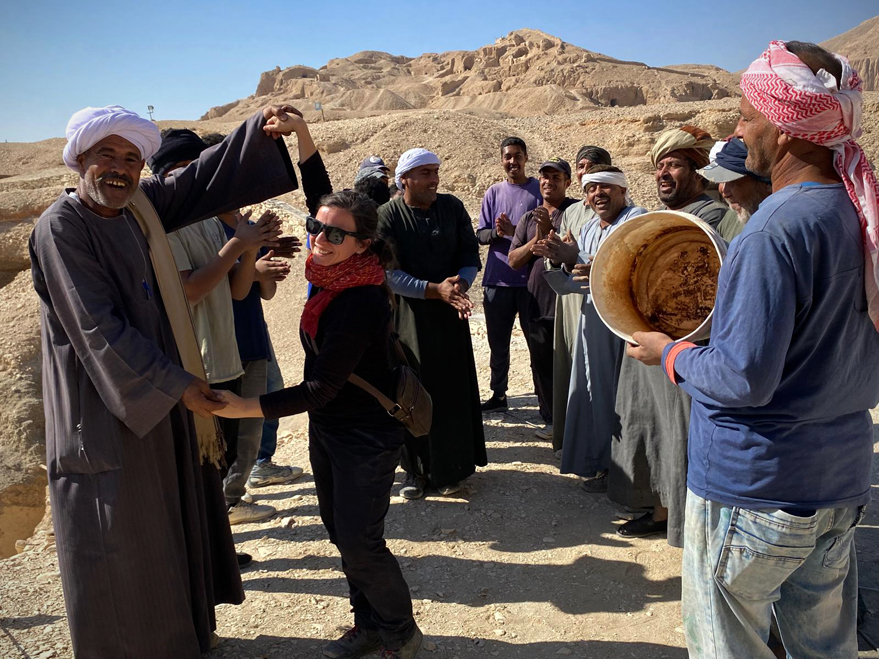
As for the tomb of Djari, we continue with the study and documentation work we have been describing these days. Despite the systematic and steady rhythm of our analysis, every glance at a scene still surprises us with the wealth of details that the artist (or artists!) of the Eleventh Dynasty included in the representation of various religious scenes and aspects of daily life. And speaking of daily life, we took advantage of breakfast today to celebrate the birthday of one of our team members, Patricia, who received congratulations from everyone and enjoy the songs and cake —with all the emotion one might imagine. Qul sana wa enti tayyiba, Bata!


