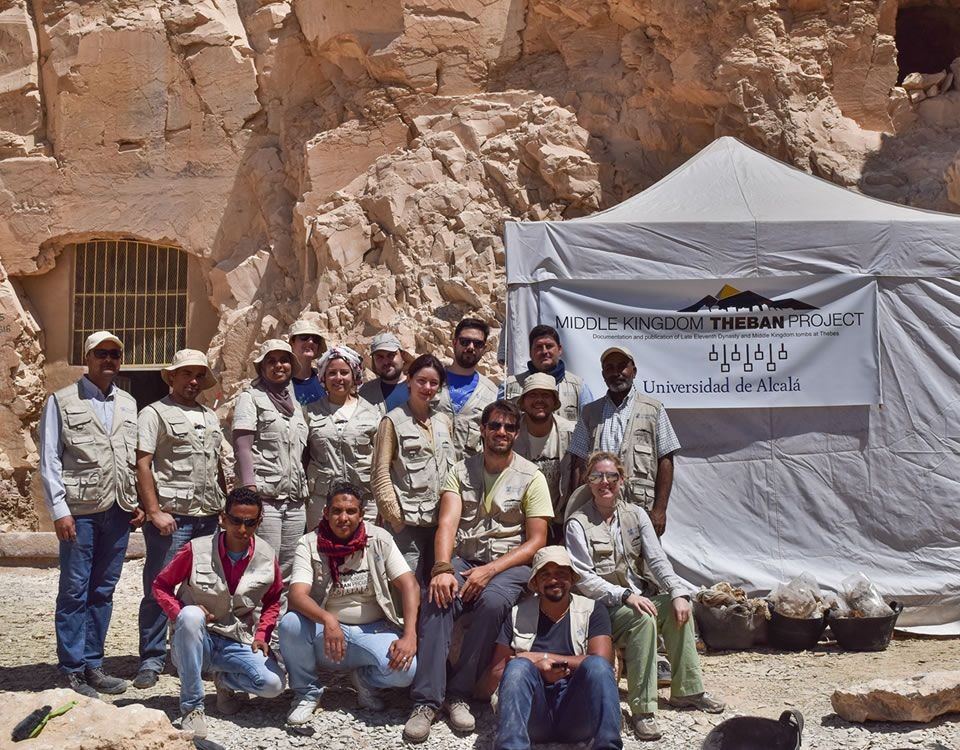
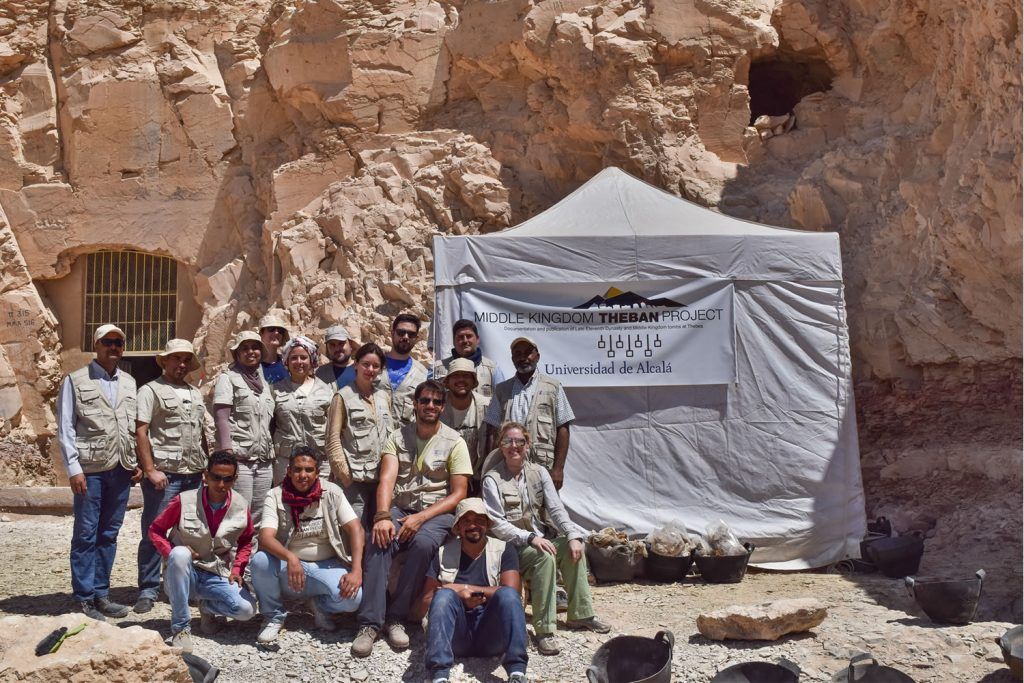
Today we finally got enough members to produce our first group-photo of the field season 2017 at Deir el-Bahari. Although Salima had to leave the site this morning for university duties and other major colleagues are still to arrive, everyone assembled in the courtyard of Ipi’s tomb wanted to keep a memory of the beginning of the campaign and, in a way, say again “thanks” to the University of Alcalá for providing us support. Besides, it was a perfect occassion since we received the visit of the Chief Manager at Deir el-Bahari, Ezz El-Din er-Noby, and the inspectors Ahmad Boghededi and Omar Fathi, who wanted to know more about our initial progress and plans.
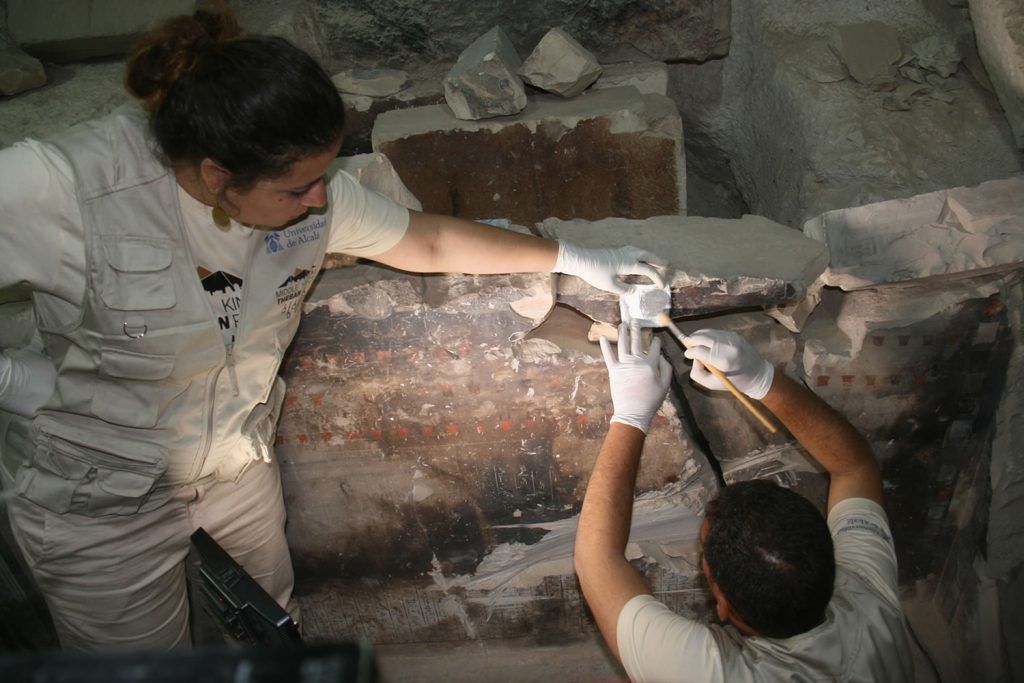
In the innermost chamber at Ipi´s tomb, the conservators Eman, Mohamed and Rawda continued testing alternative treatments on the inner surface of the sarcophagus to achieve the best possible conservation. They have confirmed that the gypsum strips placed yesterday at cracks and instable areas of the sarcophagus were still intact, which means that the cleaning of the colourful paintings and inscriptions on the inner walls can be made visible and be preserved for the future. We are hopeful to identify more and more hieroglyphic signs since parts of the sarcophagus decoration are too deteriorated and have vanished due to vandalism and the ravages of time.
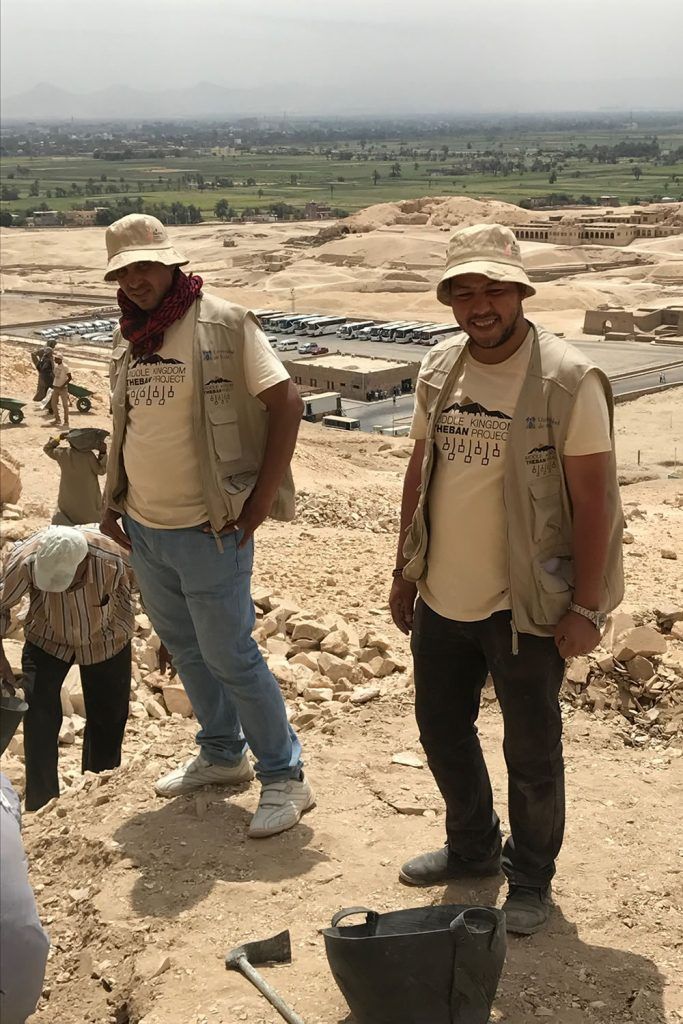
In the courtyard of Ipi’s tomb, Mohamed as the main archaeologist in this area was concentrating on the west wall of TT 315 and its limits with the neighbour tomb MMA 515, which shows still intact, ancient mudbrick structures. This work was supervised by Abd el-Ghany. To provide clarity about the sequence of the construction Mohamed was taking a series of pictures with the intention to produce a 3D model of the area. The first results indicate that the structures belonging to Ipi’s tomb are much older than those of MMA 515, and that they have been partly used as a foundation for the adjacent tomb.
In the meantime, Raúl, Ana and Dina continued sorting and documenting the embalming material and textiles found during the last field season. Due to the fact that wrappings, cloths, shrouds and natron bags were used during the mummification process and they seem to have been used for dipping the cloths into some fragrant oil or were in direct contact with the body of the deceased, they show numerous stains and a weird aspect, and above all present a hedious intense smell of natron. Considering the situation, for the protection of these team members, masks and gloves have become a must-have!

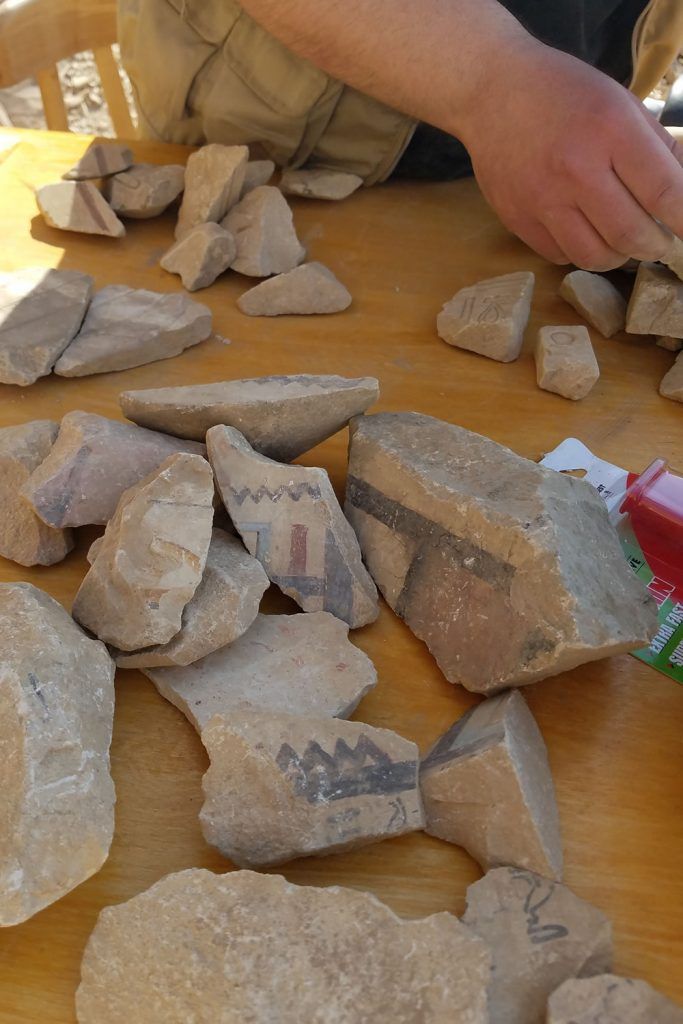
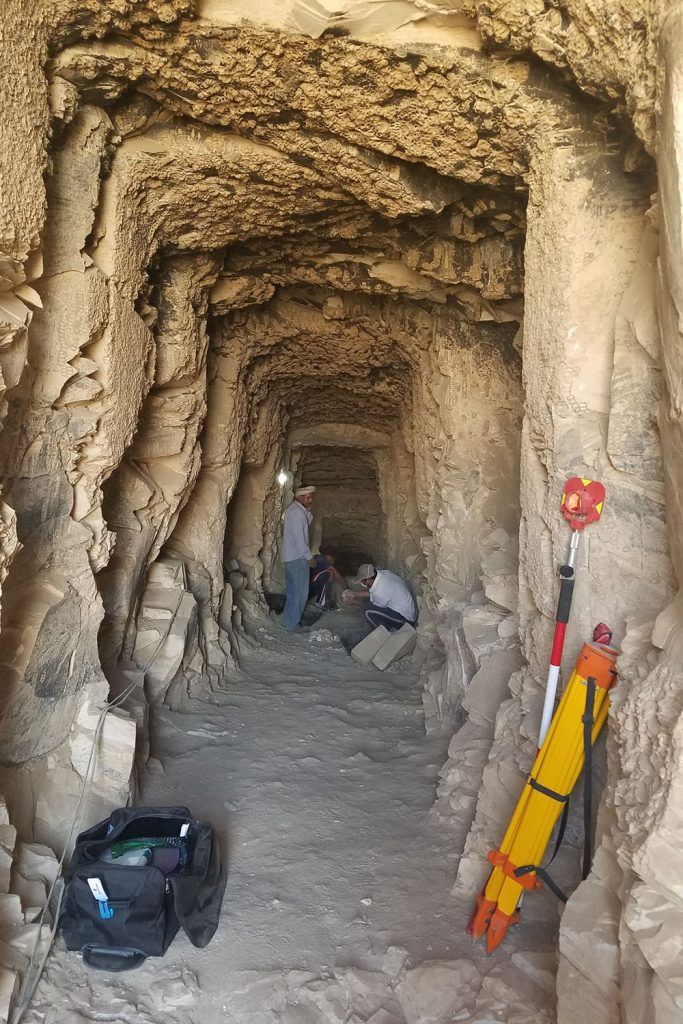
In the tomb of Henenu the cleaning of the corridor was accomplished, revealing several painted stela fragments for the tomb owner, bits from the stone sarcophagus with inscriptions in cursive hieroglyphs, as well as a particular unique piece of Roman shroud. Jónatan, who is specialised on shrouds of this time, started contextualising this interesting find immediately! Meanwhile, Kelly and Sergio continued with the setting up of the measurement points with the total station and were successful.
In general the team members are happy for the clear progress in the excavation, even if we are only in the middle of the first week, but the intensity of the work seem to require, at times, some extra hours of work in the site.


