Image: Patricia Mora Photography
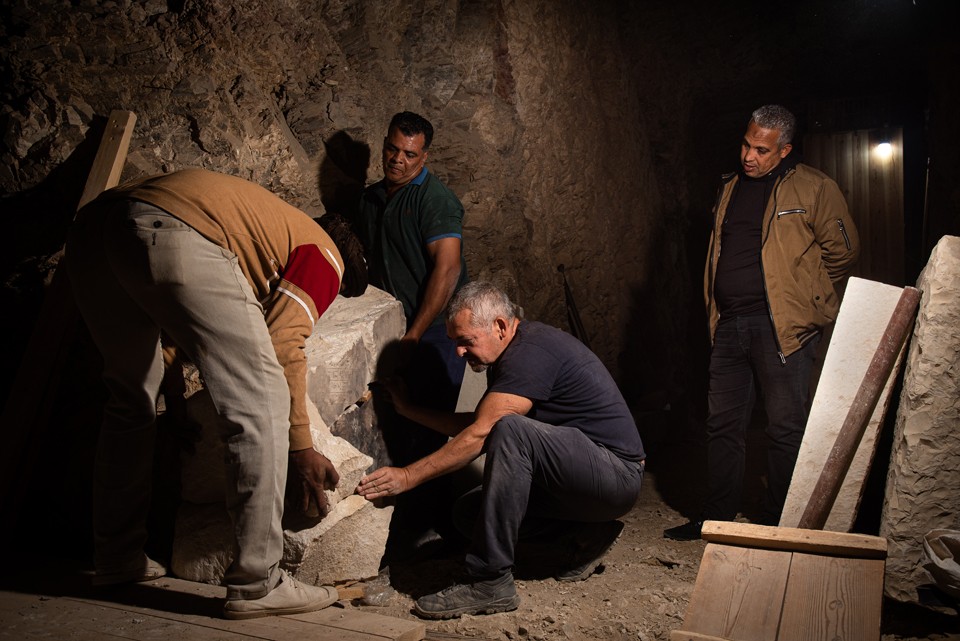
With five days remaining before the end of our campaign, there is little room to deviate from the established plans, and the team is therefore fully aware of the steps to be taken during the few working days left. In the complex of Ipi (TT 315), the objective set at the beginning of the campaign has been achieved, with the dismantling and transport of all the fragmented blocks of the vizier’s sarcophagus. In the case of Djari, director of the kheneret, restoration work remains to be completed in his funerary complex (TT 366), which will be the focus of the team’s efforts during the remaining days. While in previous weeks we were pleasantly surprised by the endurance, commitment, and dedication of the workmen, this week it is the work of our conservators that has proven especially compelling: the preliminary study of the mortars to be used, the careful testing carried out in the museum itself, and the selection of the most suitable restoration mortar have now given way to its direct application on the walls, together with close supervision to ensure that the final result meets expectations. It was no coincidence that we entitled yesterday’s entry “Mortar Combat!” in reference to the intensity and complexity of our outstanding conservators’ work—though all of it carried out with care, methodological rigor, and close attention to detail, always with the aim of revitalizing and preserving this complex, whose paintings are of exceptional quality.
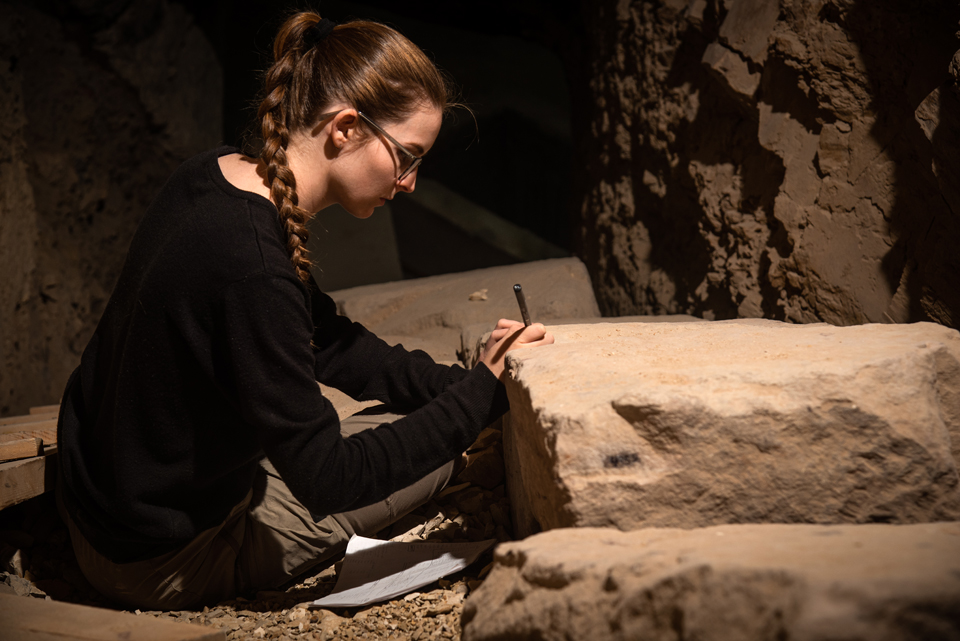
In the funerary complex of Ipi, the number of pending tasks is gradually decreasing, although the pursuit of excellence in any undertaking—as we all know well—requires finishing the work in the most appropriate manner possible. In TT 315, after the removal of a substantial portion of the stone sarcophagus and the canopic chest, only the documentation of the central element without its fragments and of the burial chamber as a whole remains. This documentation will include: (i) the collection of images of the sarcophagus (walls, floor, thermal fissures, damage, etc.), as well as of the chamber itself (its floors—there are two—its walls, the soot-blackened ceiling, and so forth); (ii) the production of photogrammetric models in order to compile all details at very high resolution and in three-dimensional format; (iii) the recording of architectural features that could not previously be observed with sufficient clarity; and (iv) the preparation of a compendium of observations to define the objectives of the next campaign. In that forthcoming season, the primary goal will be to move the remaining portion of the sarcophagus using an exoskeleton, allowing the excavation of the chamber floor and the complete reconstruction of all the fragments of Ipi’s sarcophagus and its stone canopic chest, positioned on its eastern side.
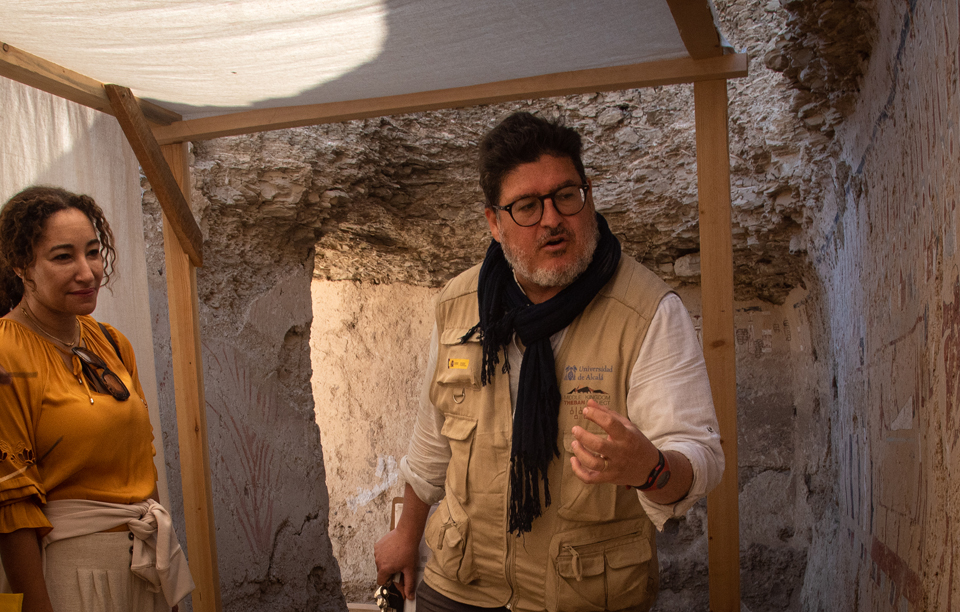
Meanwhile, the work carried out by the conservators in the transverse corridor of Djari’s tomb deserves particular praise. This space concentrates the majority of the scenes (in a pre-reunification style), characterized by exceptional color and motifs. In order to create the iconographic program, the ancient builders had to apply three layers with different compositions, which has required our conservators to study in detail the best way to replicate them. As a result, they worked intensively during the first weeks and are now racing against the clock to apply the mortars, which should dry over the coming weeks and provide an intermediate layer on which work can continue during the next campaign. This type of restoration—midway through its completion—will make it possible, in future seasons, to work on the outermost and more refined layer on which the paintings rest, thus achieving the desired recovery of the supports, colors, and forms.
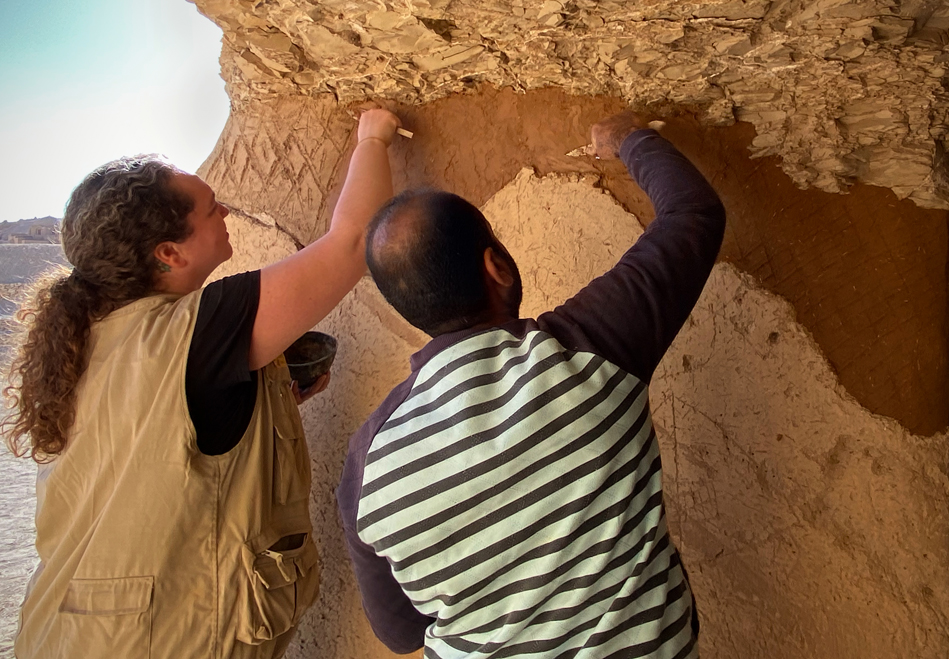
The conservation team is therefore constantly moving from one area to another, completing the program of interventions on each of the walls, pillars, and painted surfaces, exactly as planned the previous day. Each conservator’s working kit includes containers with mortars, brushes, metal and wooden spatulas, cloths, and a variety of other brushes, papers, and textiles, all employed to achieve, in record time, the most appropriate treatment for Djari’s tomb. Its scenes are highly representative of what must have been the local Theban style (perhaps even that of Upper Egypt) at the end of the Eleventh Dynasty. Midway through the morning, we were fortunate to receive the visit of Fatma Talaat Ismail (ARCE), who, while traveling privately, took the opportunity to stop by, greet the team, and inquire about the progress of the work in the complex of Djari.


