Image: Patricia Mora Photography
Today was a very special day for the members of the Ministry of Tourism and Antiquities (MoTA), as two alabaster statues from the mortuary temple of Amenhotep III were inaugurated at Kom el-Hettan (i.e., “the mound of walls”). Despite the kind invitation to attend the event (for which we are immensely grateful), we chose to continue working today in order to make the most of the final moments before closing the tenth field season. The attendees surely enjoyed the presentation of these new elements from the cult complex of the great monarch of the Eighteenth Dynasty, where the team led by the researcher Hourig Sourouzian has been working for many years.
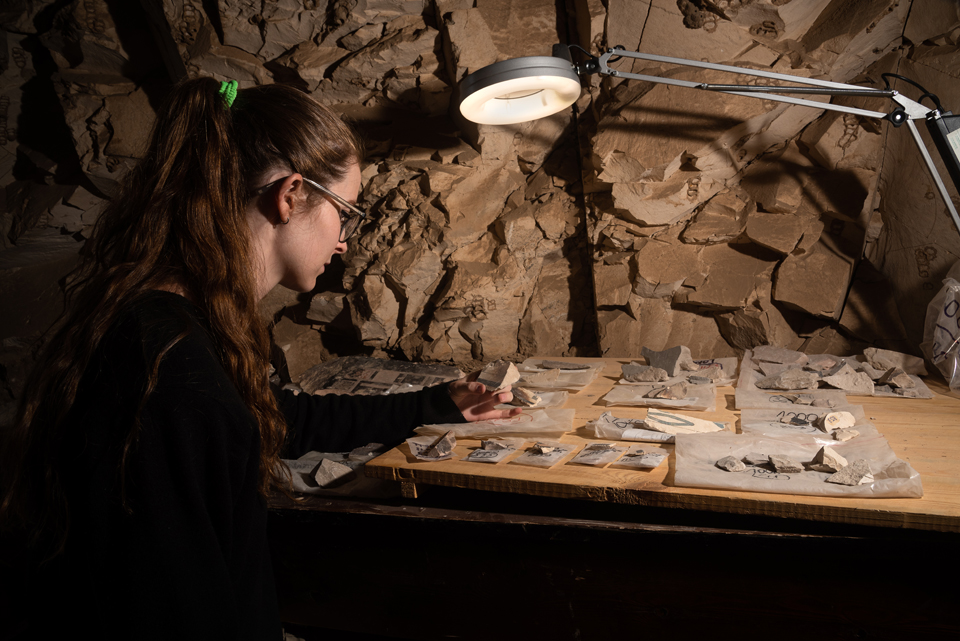
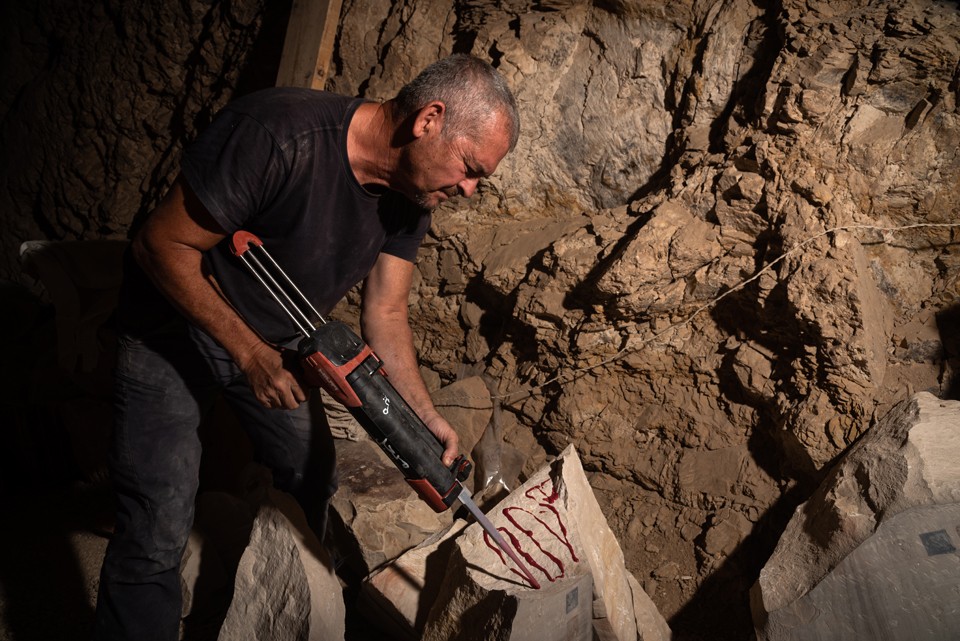
Today we reviewed the point maps obtained in previous years by the landscape archaeology team, which were also checked by Fernando. His task is to examine the network of points to verify that all the data are correct and to ensure that we are working with absolute rigor in terms of geolocation across the monuments. In addition, since Daniel has left, only the three people dedicated exclusively to the sarcophagus fragments remain at the complex of Ipi: Miguel, Rebekah, and Raúl. After the hoisting of the final block of the canopic layer, Miguel proceeded to join fragments using a special adhesive, which we hope will speed up the reconstruction process in the next campaign. Meanwhile, Rebekah worked on organizing the few remaining fragments in order to complete the inventory.
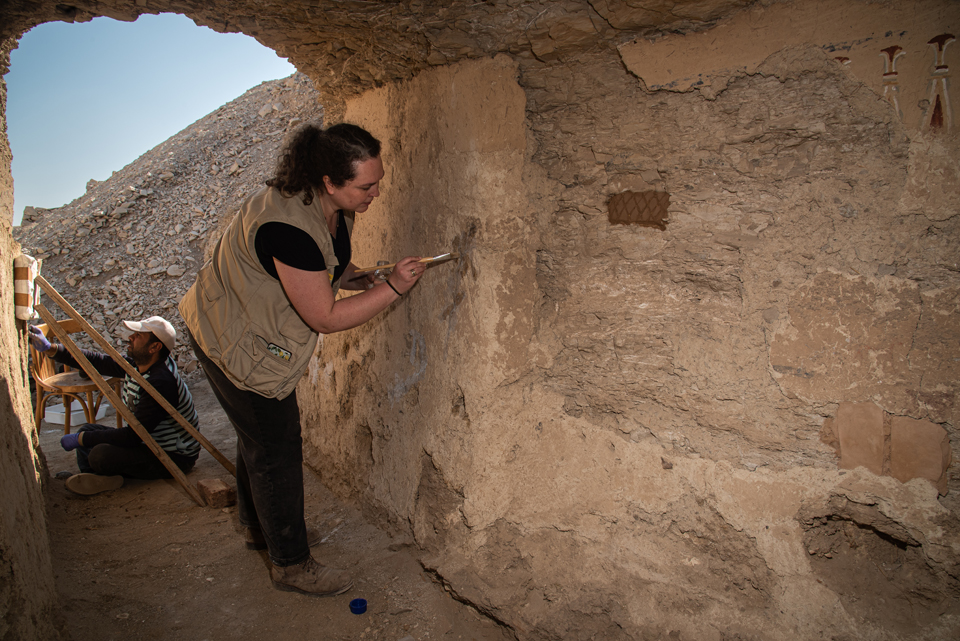
At the complex of Djari, work has continued on the restoration of its walls, mortars, and paintings. Sameh and Reed focused on the restoration of a particularly complex area that has priority status due to the fragile condition of the pillars and walls in the southern sector of the transverse corridor. In this area, a specially formulated mortar is being tested to provide the necessary support while also maintaining a degree of flexibility, so as not to damage the layers with which it will come into contact once applied to the wall.
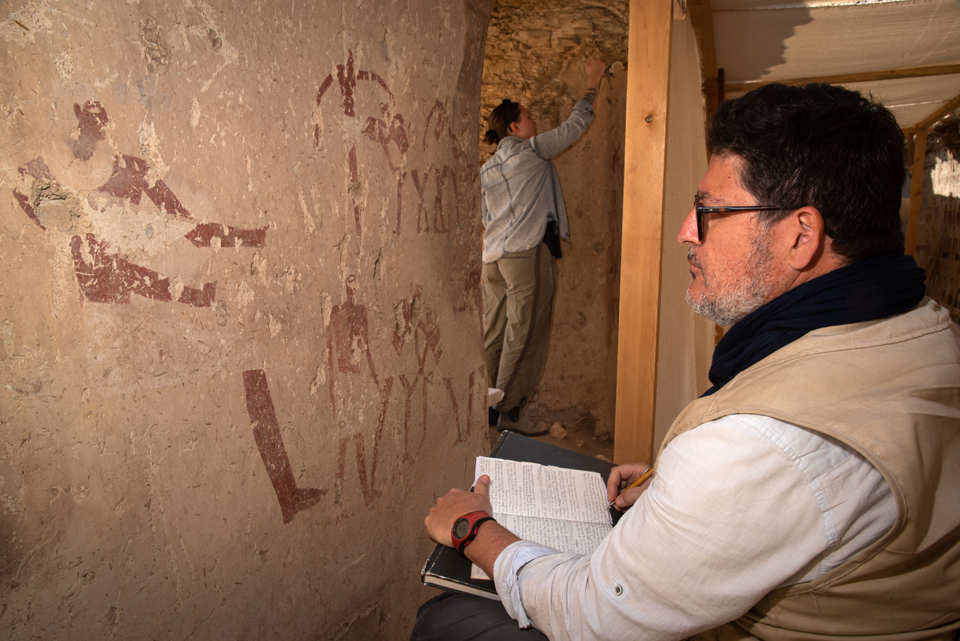
Meanwhile, as the conservators continue their restoration work, Antonio has made progress in examining the iconographic and textual programs within the tomb. Although many of the scenes are common to other tombs, it is often the details that compel us to understand this monument as the product of a distinct local style, different from that seen in other tombs. For example, the leather sandals of the drovers with their donkeys, or the arm of the lector priest positioned behind the sledge used to drag Djari’s coffin, are two details that reveal an artistic production with an idiosyncrasy and techniques specific to a local workshop. In addition, it is important to compare the inscriptions and their condition some 90 years ago, when they were photographed by the Metropolitan Museum expedition, with the state in which they are preserved today.


