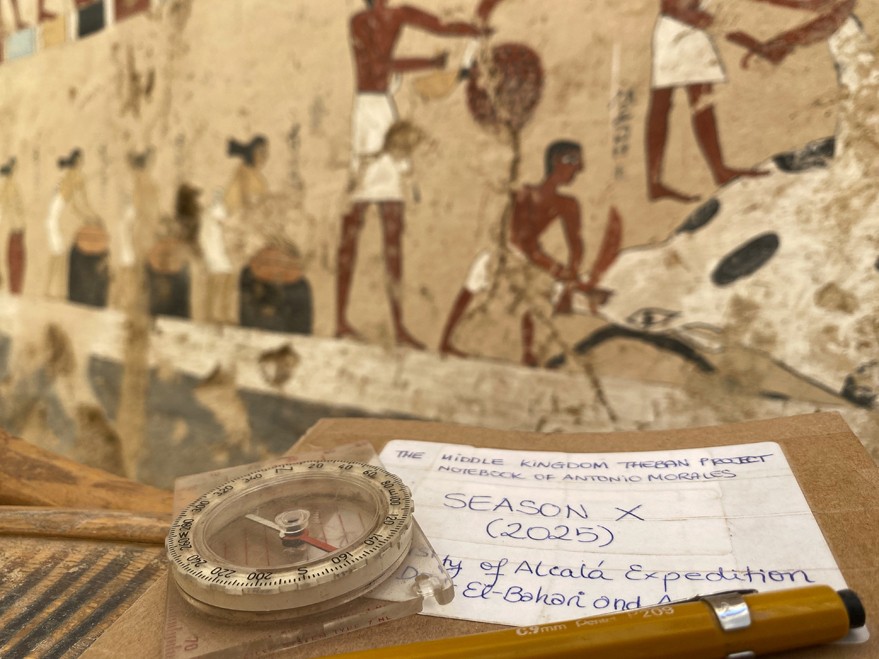
Image: Antonio Morales
The morning began with the assembly of the remaining jaimas, which will shelter Djari’s wall-paintings over these intense weeks of documentation and restoration. As we mentioned yesterday, these portable modules can be moved if needed, either to protect the paintings from the harsh sunlight or to make the specialists’ work easier. Meanwhile, rais Ali gave precise instructions so that the small team of workers could set about their tasks —whether making their way to Ipi’s tomb, some 450 meters from Djari or descending into Djari’s courtyard to begin restoration alongside Sameh and Arantxa.
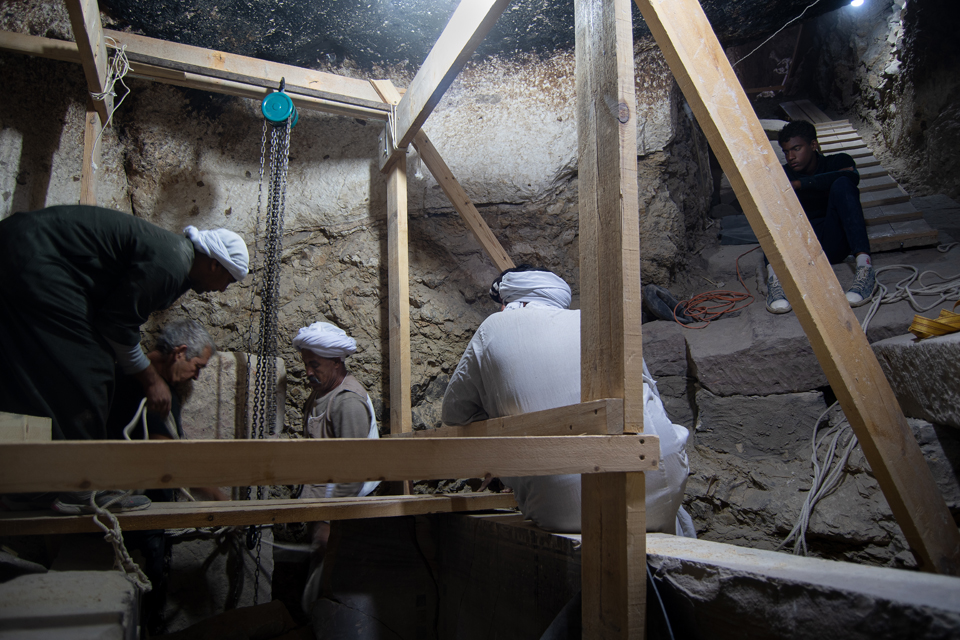
Inside Ipi’s burial chamber, the labor of transporting stone blocks continued unabated. Today, after five days of strenuous effort, copious sweat, and numerous rallying chants to lift some of the monoliths, the chamber is noticeably freer of blocks and fragments that might have collapsed otherwise. For the next couple of days, it will remain sealed, without its ba-spirit observing—perhaps puzzled by all the movement—as we gradually dismantle his sarcophagus. Over the week, roughly 1,650 kg of stone fragments and blocks have been removed from the chamber, offering a strikingly different view of the funerary space surrounding the sarcophagus. Meanwhile, Rebekah and Raúl have continued cataloguing the finds, paving the way for a smooth reconstruction. Given the centuries of burial, we believe the spirit of the vizier Ipi would be pleased with the mentioning of his name, the restoration of his tomb and sarcophagus, and the recovery of the sacred texts that once guided and protected him on his journey to the afterlife.
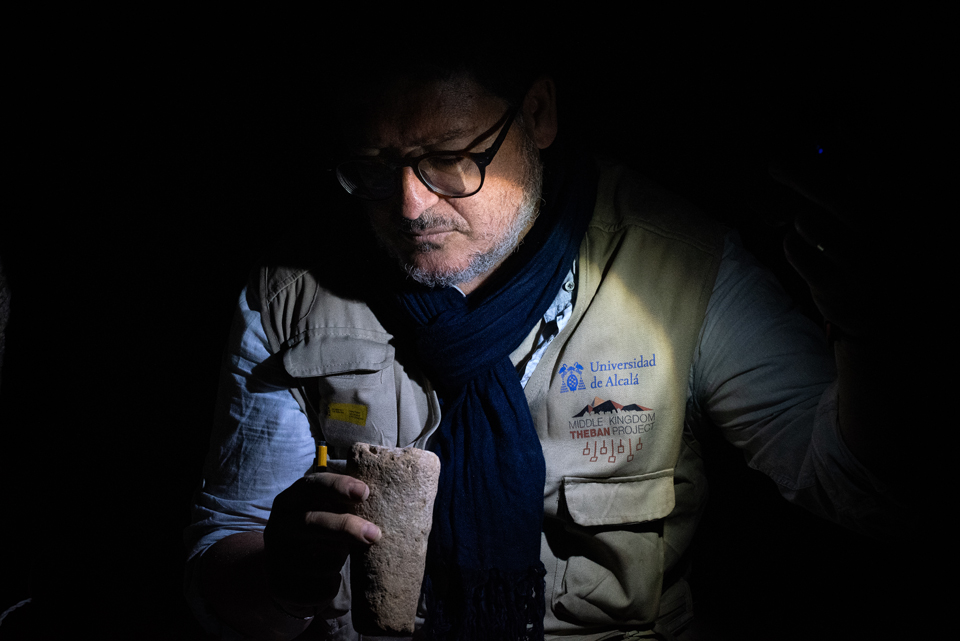
As for restoration and documentation in Djari’s tomb, the previous flurry of preparations, tests, and surveys gave way today to a calmer yet meaningful day, largely due to the variety of tasks completed inside the tomb. Andrés took the opportunity to plan —with our team’s photographer— which motifs and details should be photographed on Saturday, after the weekend (in Egypt, this includes Thursday afternoon and Friday). Capturing these motifs is essential for Andrés’s research into fishing activities once the campaign resumes.
At the same time, Arantxa and Sameh were assessing the effectiveness of the mortars tested by our conservation team during the previous campaign. These three mortars correspond to types 1, 2, and 3 in our classification, each made from different compounds. If the Theban gods (Amun, Montu, Mut…) allow, Djari’s tomb will regain part of its former splendor, and we hope its owner will be satisfied with the preservation of his name in the community’s memory —at least in the academic one. Meanwhile, inside the tomb, Antonio continued examining the funerary cones discovered a couple of years ago, preparing them for publication. These cones, dating to the reigns of Hatshepsut and Thutmosis III, were found in Djari’s complex and deserve a thorough study.
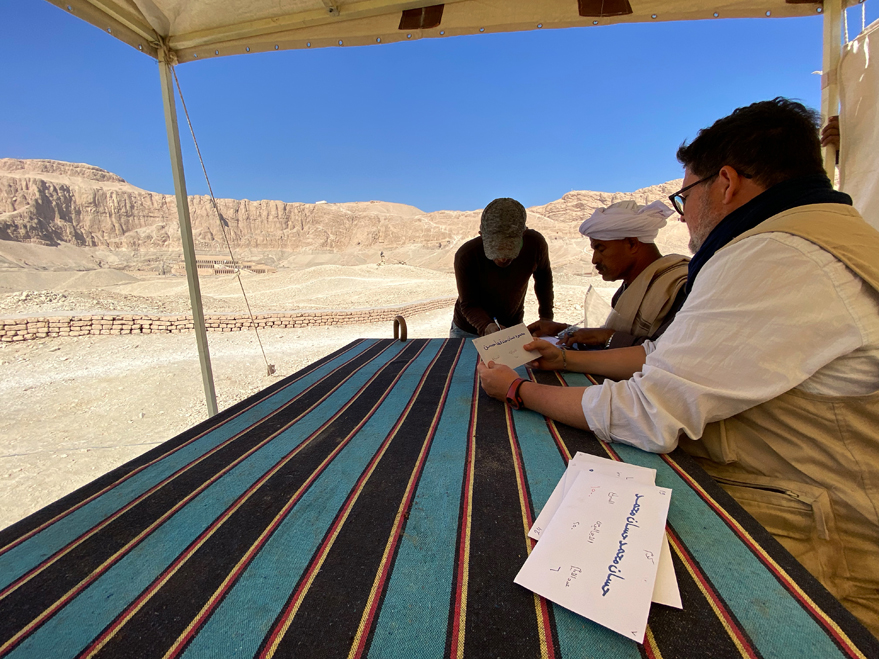
Moreover, today was payday, marking the start of the weekend. The weekly wage payment is a ritual of long-standing tradition, celebrated and upheld by the ru’asā’ (plural for “rais” or foreman) of highest lineage. Beyond simply distributing wages, this ceremony personally acknowledges each man’s effort, dedication, and contribution. In addition to the regular payment, our director greeted each worker and discussed the recent tasks and plans for the weeks ahead. These men, arriving each morning from nearby villages, have honed over the years the full range of skills needed in the necropolis, making them indispensable specialists for any project in the area.


