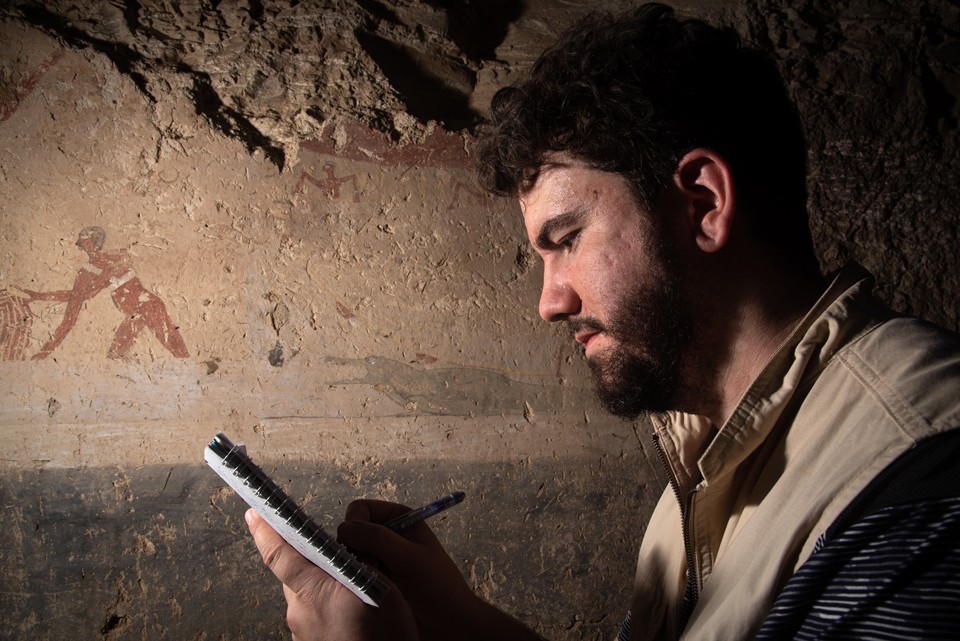
At the Annual Meeting of the American Research Center in Egypt, held in April 2024 in San Francisco, the director of our project presented the latest work carried out in the funerary complex of Djari (TT 366). Although the restoration of the wall paintings was not yet advanced, the team had already recognized the importance of the tomb’s decorative program. Its significance lies not only in the variety of themes represented (fight, funerary ritual, fishing, daily work, offerings) but also in what appears to be a combination of two stylistic traditions corresponding to the two periods lived by Djari, before and after the reunification of ancient Egypt. As part of the research derived from our project, Andrés is studying one of the most intriguing scenes in the tomb —a composition that depicts three different fishing techniques. The cultural, social, and even ecological insights arising from this scene are numerous, and Andrés will surely succeed in contextualizing and explaining its meaning within the broader framework of Djari’s decorative program.
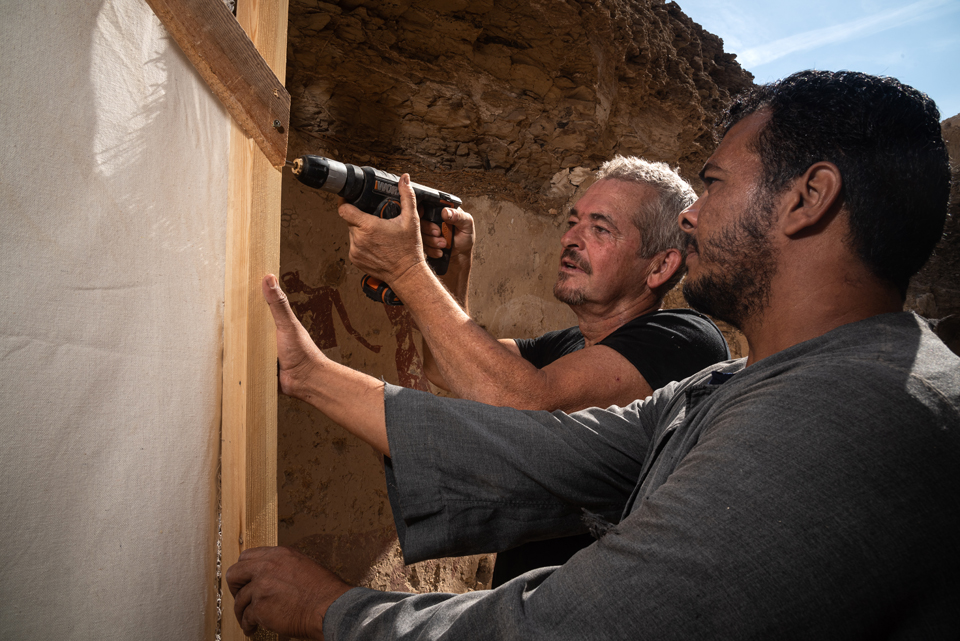
As a support for the documentation activities in the complex of Djari, we have built a series of haimas to protect the paintings, provide shade for the researchers, and ensure that both documentation and restoration proceed properly. Miguel, with the help of a couple of workers, prepared these wooden shelters with canvas roofs, which will greatly contribute to safeguarding the decorative program. Thanks to a modular system of portable shelters, we can reposition or dismantle them whenever needed, making this method particularly useful for those working in the transversal corridor. This system will allow Patri to continue documenting the decoration through traditional and multispectral photography, while conservators carry out treatments without major obstacles.
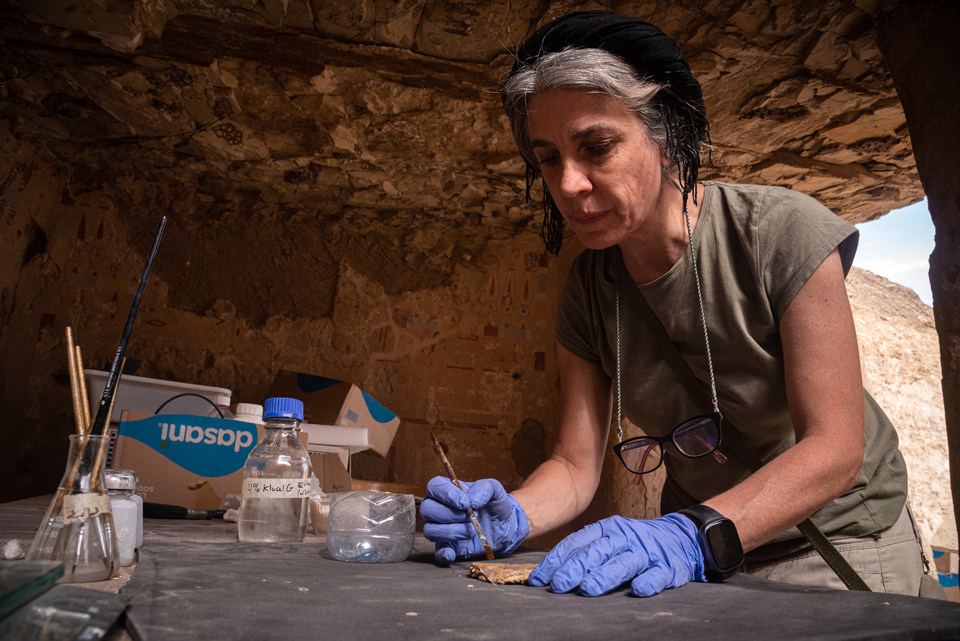
Regarding the rest of the day tasks, work continued in the sarcophagus chamber of Ipi with the transport of a 650 kg sandstone block. Originally part of the tomb floor, moving this piece to the main corridor will allow us to continue work on the sarcophagus chamber. For moving the blocks, in addition to the wooden structure equipped with the winch, we use a system of straps that makes it possible to haul each piece safely. Meanwhile, and engaged in a completely different type of task, Arantxa applied consolidation techniques to fragments of fallen mortar from previous seasons, which will gradually need to be repositioned on the tomb walls.
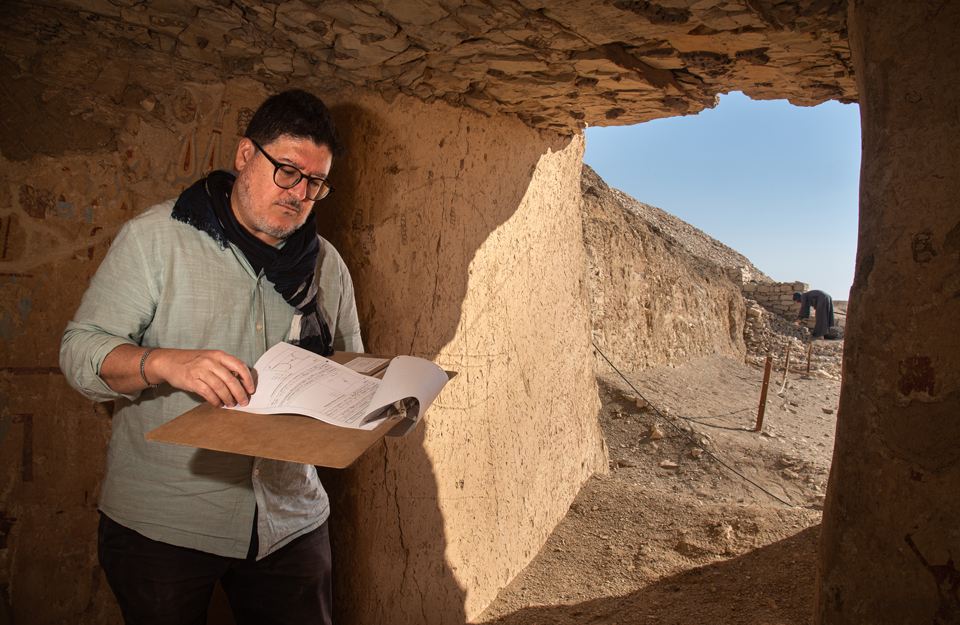
At the end of the morning, upon returning from the site, Patricia, Jaume, and Antonio took part in a meeting with an Italian research team to discuss the possible ramifications of using the hyperspectral camera. This camera —which captures images across multiple wavelength ranges of the electromagnetic spectrum— allows us to take recordings of specific wall sections (known as “cubes”) and to identify the materials used in the representations (pigments, inks) as well as the supports (layers and treatments). In doing so, it contributes to a deeper understanding of the ancient artistic and technical production processes.


